




Who is Sanjna?
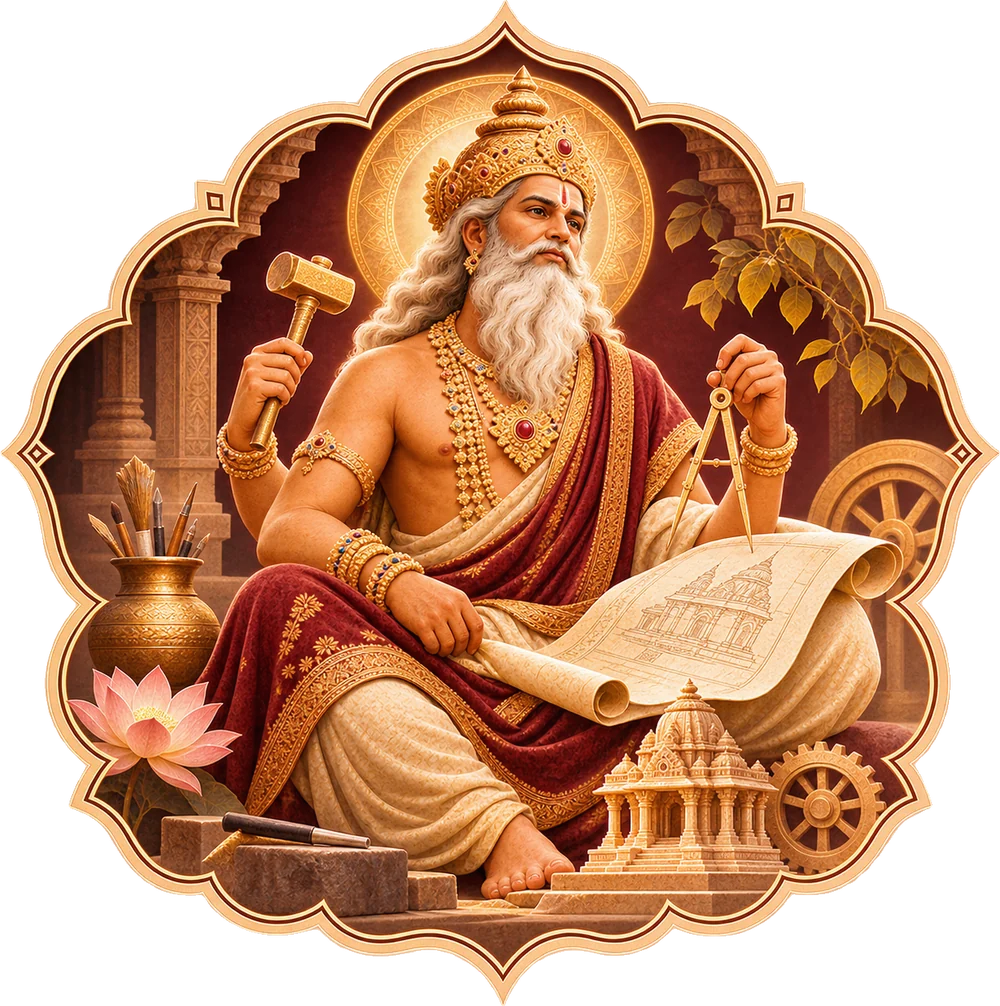
Sanjna is the daughter of Vishvakarma, the architect of the gods. Her name means “consciousness” or “recognition”. In the Rigveda she is called Saranyu.
She is married to Surya, the sun god. The two have three children. The eldest is Manu, the forefather of humankind. Then come twins: Yama, later lord of the dead, and Yami, the goddess of the river Yamuna.
The marriage has a difficulty. Surya's radiance is unbearable. Sanjna cannot look at him. Near him she screws up her eyes and suffers from the heat. Surya takes this for dislike and is hurt.
How does Chhaya come into being?
At last Sanjna can bear it no longer. She says nothing to her husband. She takes her own shadow and forms from it a woman who resembles her perfectly. She is called Chhaya, “shadow”.
Stay here in my place, says Sanjna. Be good to my children. Tell no one who you are. Chhaya promises, as long as no one threatens her with a curse.
Sanjna goes to her father. Vishvakarma sends her back. A wife belongs with her husband, he says. Sanjna does not obey. She takes the form of a mare and goes into the forests of the north. There she lives as an ascetic.
How does Surya notice the exchange?
Surya notices nothing. He lives with Chhaya, and they too have children. One is Shani, the planet Saturn. Another is a second Manu, who will rule in a future world age. The daughter is called Tapati.
In time Chhaya favours her own children. The elder ones receive less attention and less to eat. Manu bears it. Yama, young and hot-headed, rebels. In anger he raises his foot against her.
Chhaya curses him. Your foot shall fall off, she says. Frightened, Yama runs to his father.
Surya grows suspicious. A mother does not curse her child, he says, whatever it has done. He confronts Chhaya. When he himself threatens her with a curse, she confesses everything.
He cannot lift the curse. He softens it. Worms shall carry a little flesh from Yama's foot to the earth. So the word is fulfilled, and the foot is preserved.
How does the sun lose part of its radiance?
Surya hurries to Vishvakarma. The architect explains the reason for Sanjna's flight. Your radiance is too strong, he says. If you wish, I will take some of it away.
Surya agrees. Vishvakarma sets him on his lathe and grinds off an eighth of his rays. According to other versions it is fifteen sixteenths. What remains is a beautiful, bearable form.
From the glowing shavings he forges weapons for the gods: the discus of Vishnu, the trident of Shiva and the spear of Murugan.
How do Surya and Sanjna find each other again?
Through inner vision Surya recognises where his wife is. He takes the form of a stallion and goes to her in the forests of the north.
At first the mare does not recognise him and turns away. Then they meet. From this meeting come the Ashvins, the divine twins with horses' heads. They are the physicians of the gods.
Surya shows himself in his new, milder form. Sanjna takes on her own shape again and returns with him. Chhaya remains part of the family.
Each child receives its task. Yama, who has experienced injustice, becomes judge of the dead and is called Dharmaraja, “king of justice”. Shani becomes the planet that tests people's deeds.
What does the story mean?
The story is first of all an image from nature. The shadow belongs to the sun. Where the light is too strong, darkness arises as its counterpart. The two women are two sides of the same figure.
Sanjna's name means consciousness. Teachers read her flight like this: pure knowledge can dazzle. It has to be softened so that one can live with it. Only dimmed light can be looked at.
Read in human terms it is about two people who do not talk to each other. Sanjna keeps silent about her suffering. Surya misunderstands her behaviour. The solution comes when the stronger one is ready to give up some of his power.
That the ground-off rays become the weapons of the gods has a charm of its own. What harms in excess becomes useful elsewhere.
Where is the story told?
It is told in detail in the Markandeya Purana and more briefly in the Vishnu Purana, in the third book, chapter 2. A very short early form is in the Rigveda, hymn 10.17.
In some texts Sanjna is also called Samjna, Saranyu or Sandhya. In Indian astrology the opposition between Surya and his son Shani plays a large role. More on this is under the Navagraha, the nine planetary deities.
You will find more stories and all the figures at a glance in the library of the gods.
Frequently asked questions
Who is Chhaya?
Chhaya is the shadow of Sanjna, the wife of the sun god. Sanjna formed her as her likeness and left her behind in her place.
Why did Sanjna leave the sun god?
She could not bear his excessive radiance and heat. Only when part of it had been ground away did she return.
Who are Surya's children?
With Sanjna he has Manu, Yama, Yami and the Ashvins. With Chhaya he has Shani, a second Manu and Tapati.
Who are the Ashvins?
The Ashvins are divine twins, often shown with horses' heads. They are regarded as the physicians of the gods and as helpers in need.