




Who is Surya?
Surya is the god of the sun and one of the oldest deities of Hinduism. His name is the Sanskrit word for sun. He brings the day, light and life.
The Rigveda says the sun is the self of all that moves and all that stands still (Rigveda 1.115.1). The whole of hymn 1.50 is dedicated to it. Beside him there are other sun gods such as Savitr, Mitra and Pushan, who embody different sides of light.
Today he is one of the nine planetary deities and has his own temples. The overview Hindu gods shows how he fits into the world of the gods.
How is the sun god depicted?
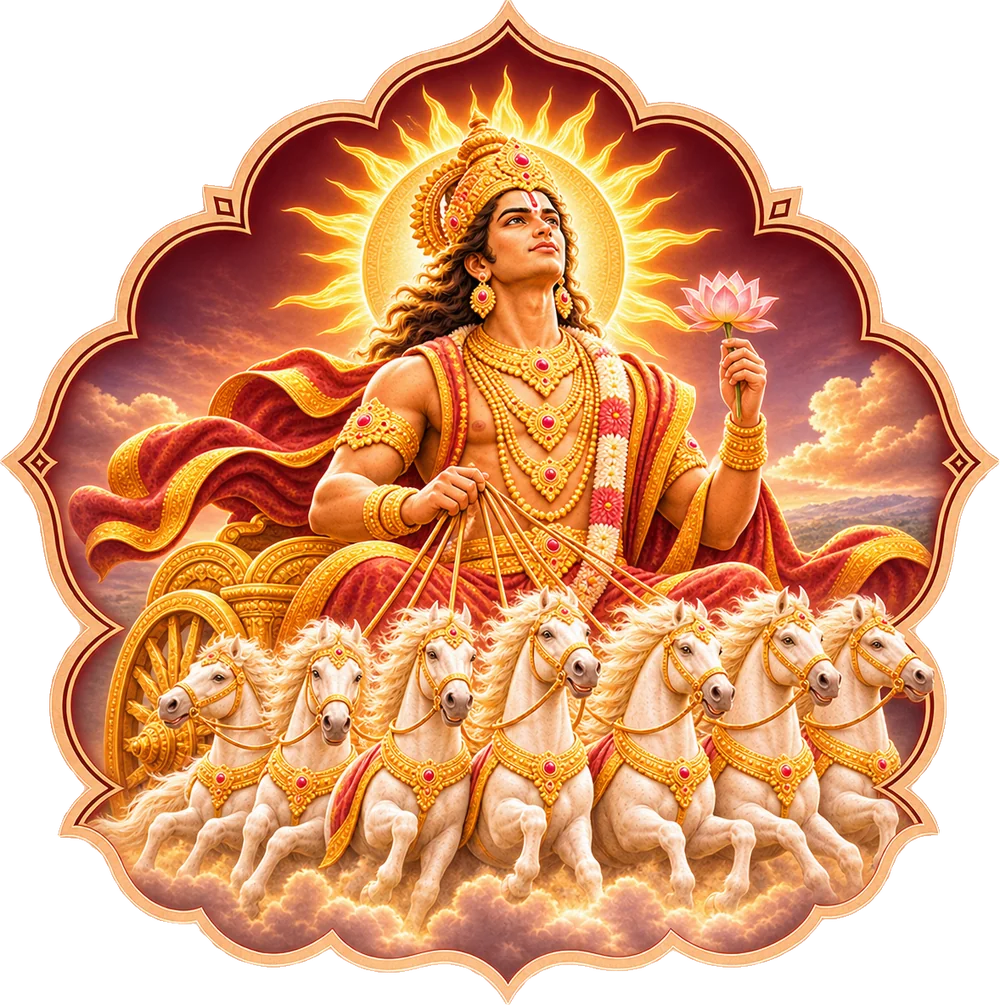
The sun god drives a golden chariot drawn by seven horses. His charioteer is Aruna, the god of dawn. In each hand he usually holds a lotus, which opens with the sunlight.
The seven horses are often read as the seven colours of light or the seven days of the week. In many depictions the chariot has only one wheel. It stands for time, which turns without end.
In old statues from North India he wears high boots. Scholars take this as a sign of influences from Central Asia and Iran, where the sun was also worshipped.
Surya and the Gayatri mantra
The Gayatri mantra is addressed to Savitr, the enlivening power of the sun. It is in the Rigveda (3.62.10) and is regarded as one of the holiest verses of Hinduism. In it the one who prays asks the divine light to illumine their mind.
Savitr and Surya are often equated, even though in the Veda they show different aspects. Savitr is the sun as impulse, which wakes beings and sets them in motion. So whoever says the Gayatri at sunrise turns to the sun as the source of insight.
Read moreGayatri Mantra: Meaning, Lyrics and Word-by-Word TranslationThe 12 names in the sun salutation
Many people know the sun god from yoga, from the sun salutation, Sūrya Namaskār. In the tradition one name of the sun is spoken with each of the twelve rounds, always with “Om” before it and “namaḥ” after.
| No. | Mantra | Meaning |
|---|---|---|
| 1 | oṃ mitrāya namaḥ | to the friend of all |
| 2 | oṃ ravaye namaḥ | to the radiant one |
| 3 | oṃ sūryāya namaḥ | to the one who impels |
| 4 | oṃ bhānave namaḥ | to the shining one |
| 5 | oṃ khagāya namaḥ | to the one who moves across the sky |
| 6 | oṃ pūṣṇe namaḥ | to the nourisher |
| 7 | oṃ hiraṇyagarbhāya namaḥ | to the golden seed |
| 8 | oṃ marīcaye namaḥ | to the lord of rays |
| 9 | oṃ ādityāya namaḥ | to the son of Aditi |
| 10 | oṃ savitre namaḥ | to the enlivener |
| 11 | oṃ arkāya namaḥ | to the one worthy of praise |
| 12 | oṃ bhāskarāya namaḥ | to the bringer of light |
A simple Surya mantra
The shortest mantra to the sun god is the third name in the series. You can say it in the morning while looking towards the rising sun.
Om, salutation to the sun.
| Word | Say it like | Meaning |
|---|---|---|
| oṃ | om | the sacred primordial syllable |
| sūryāya | soor-yaa-ya | to Surya, the sun |
| namaḥ | na-mah | salutation, greeting |
A traditional morning custom is Arghya: you pour water from a copper vessel towards the sun while saying a mantra. In the Ramayana the sage Agastya teaches the hero Rama the hymn Aditya Hridayam, the “heart of the sun”, before the great battle.
Family and stories
According to the Puranas Surya married Sanjna, the daughter of the divine architect Vishvakarma. She could not bear his heat and left her shadow, Chhaya, in her place. Well-known children came from both unions.
They include Yama, the god of death, the river goddess Yamuna and Shani, the planet Saturn. In the Mahabharata the hero Karna is a son of the sun god and Queen Kunti.
In the Rigveda the relationship with Indra is close. After his victory over the serpent Vritra, Indra brings forth sun, sky and dawn (Rigveda 1.32.4). There the sun is regarded as the fruit of the order he wins in battle.
Stories about Surya to read
You can read these stories about Surya in full here. Each has its own page with its meaning and where it appears in the scriptures.
- Surya and Sanjna: The sun god’s wife cannot bear his radiance. She leaves her shadow behind and flees. Read the whole story
Temples and festivals of the sun
The most famous sun temple stands in Konark in Odisha. It was built in the 13th century as a huge stone chariot with 24 wheels and seven horses and is a UNESCO World Heritage Site. Other well-known temples are in Modhera in Gujarat and Martand in Kashmir.
Sunday, Ravivāra, is dedicated to him. The most important festivals follow the course of the sun:
- Makar Sankrantithe sun’s entry into the sign of Capricorn, usually on 14 or 15 January. Celebrated in Tamil Nadu as Pongal.
- Ratha Saptamiregarded as the birthday of the sun, in the month of Magha.
- Chhath Pujaa big festival in Bihar and eastern India, six days after Diwali, with prayers to the rising and setting sun.
If you want to get to know the sun god, it is best to begin with the Gayatri mantra. It links the light of the sun with the request for a clear mind.
Frequently asked questions
Who is Surya in Hinduism?
Surya is the god of the sun. He drives across the sky in a chariot with seven horses and gives light and life.
How many horses does Surya have?
His chariot is drawn by seven horses. They are often read as the seven colours of light or the seven days of the week.
Is the Gayatri mantra addressed to Surya?
It is addressed to Savitr, the enlivening power of the sun. Savitr and Surya are often equated.
Which day belongs to Surya?
Sunday is dedicated to the sun god. In Sanskrit it is called Ravivara, the day of the sun.
What does Surya have to do with the sun salutation?
The sun salutation is a bow to the sun. Traditionally one of the twelve sun names is spoken with each round.