




Who is Shiva?
Shiva is one of the three great gods of Hinduism. In the triad of creator, preserver and dissolver he stands for dissolution. What is meant is the end of the old, so that something new can arise. A good image for it is the forest fire after which the forest grows anew.
In Shaivism, one of the great currents of Hinduism, he is far more. There he alone creates, sustains and ends the world. The Shvetashvatara Upanishad, probably composed in the last centuries BCE, already praises him as the one lord. For Vaishnavas, on the other hand, Vishnu stands highest. The page Hindu gods gives an overview of all deities.
Hardly any god unites so many opposites. He meditates as a yogi on Mount Kailash and is still a husband and father. He dances the world into motion and lives on cremation grounds. In yoga he is regarded as Adiyogi, the first yogi. The 15th-century Hatha Yoga Pradipika begins with a salutation to Adinatha, the “first lord”, and its commentaries see Shiva in him.
What does the name Shiva mean?
The Sanskrit word śiva means “kind, friendly, auspicious”. In the Rigveda it is only an epithet. There the god is called Rudra, probably “the roarer”. He is a feared lord of storms who also gives healing herbs. Only a few hymns there are dedicated to him.
Over time the friendly epithet became the main name. The Shri Rudram of the Yajurveda contains the line namaḥ śivāya ca śivatarāya ca, “salutation to the kind one and the kinder one”. The five-syllable mantra comes from it.
The Shiva Purana and the Mahabharata each hand down a list of a thousand names. You will meet these five especially often in songs:
- Mahadevathe great god.
- Natarajathe king of dance.
- Pashupatithe lord of all living beings.
- Nilakanthathe one with the blue throat.
- Shankarathe benefactor.
How old Shiva is cannot be said exactly. A seal from the Indus culture shows a seated figure with horns, surrounded by animals. In 1931 the archaeologist John Marshall called it “Proto-Shiva”. Many scholars today regard this reading as uncertain.
What do Shiva’s symbols mean?
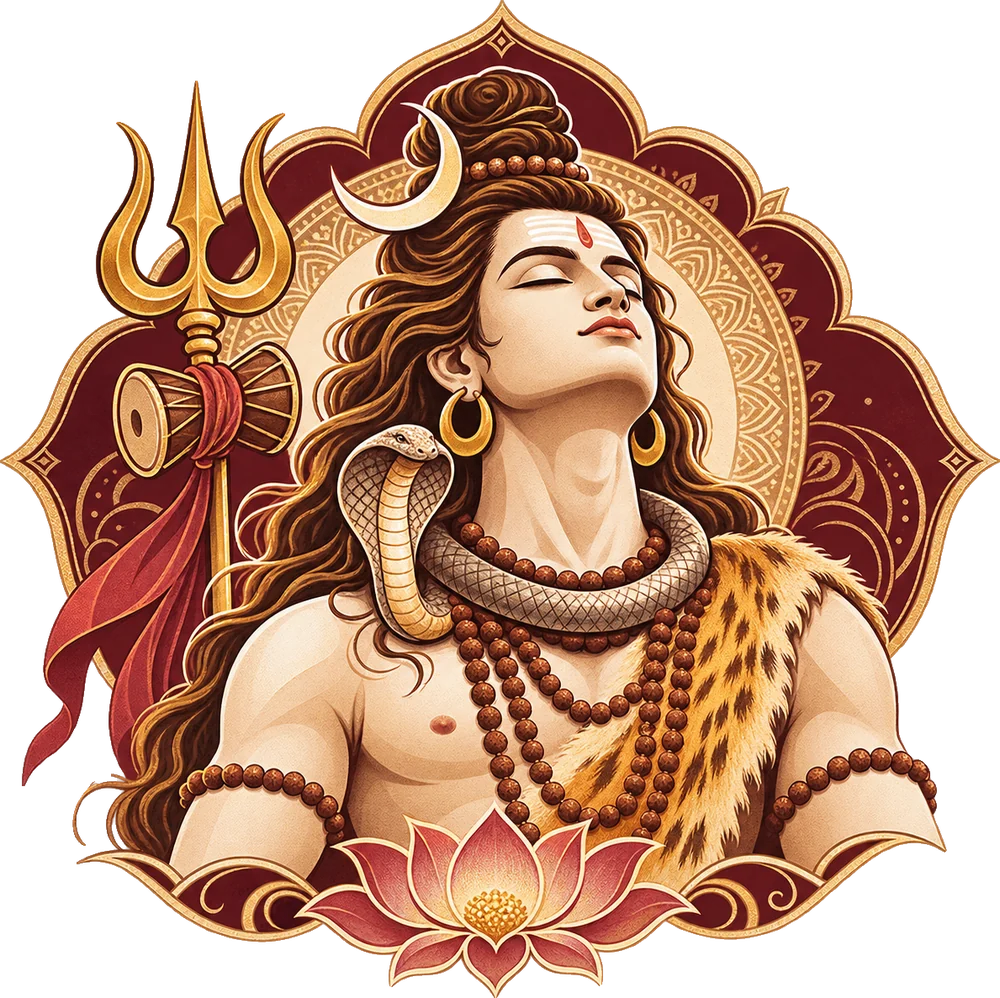
Almost every detail in his pictures tells a story. The table shows the most important symbols and their common reading.
| Symbol | Meaning |
|---|---|
| Trident (Trishula) | Creation, preservation and dissolution, often also the three gunas. |
| Third eye | Insight that burns away illusion. With it he burned Kama, the god of desire. |
| Crescent moon | Time and return, since the moon wanes and waxes again. |
| Ganga in his hair | He catches the heavenly river so that its fall spares the earth. |
| Snake around the neck | Fearlessness and tamed power. |
| Drum (Damaru) | The primordial sound. According to tradition the sounds of Sanskrit arose from its beat. |
| Ash (Vibhuti) | The impermanence of all forms. |
| Nandi the bull | His mount and most loyal servant, often before the temple gate. |
| Rudraksha | Seeds for the prayer beads, according to legend Shiva’s tears. |
The article Hindu symbols explains how this imagery returns with other gods.
What is the Shiva lingam?
The lingam is Shiva’s most important cult image. The Sanskrit word liṅga means “sign, mark”. It is usually a smooth, rounded stone on a base, the yoni. It shows the god without a face and without a fixed form.
Believers read lingam and yoni together as the unity of Shiva and Shakti, of consciousness and power. Scholars also point to an old fertility symbolism. Colonial-era authors stressed almost only this side. For most Hindus today the formless is in the foreground.
In the worship, the abhiṣeka, believers pour water, milk or honey over the stone and lay bilva leaves on it. The most famous pilgrimage sites are the twelve Jyotirlingas, the “lingams of light”. They include Kashi Vishwanath in Varanasi, Somnath in Gujarat and Kedarnath in the Himalaya.
Which stories are told about Shiva?
Most stories are in the Puranas, the great collections of myths, especially the Shiva Purana and the Linga Purana. Some are also handed down in the epics. These are the best known:
- The churning of the ocean of milkGods and demons churn the ocean to win the drink of immortality. First a deadly poison rises. Shiva drinks it to save the world, and it turns his throat blue (Bhagavata Purana, book 8). Read the whole story
- The descent of the GangaKing Bhagiratha asks that the heavenly river come down to earth. Shiva catches the water in his hair and lets it flow down slowly (Ramayana, Bala Kanda). Read the whole story
- The pillar of lightBrahma and Vishnu argue over who is greater. Then an endless pillar of fire appears. Neither finds its end, and Shiva steps out of it (Shiva Purana, Linga Purana). Read the whole story
- Kama turns to ashThe gods send Kama, the god of love, to wake Shiva from his meditation. Shiva opens his third eye and burns him. Only Parvati’s perseverance wins his heart (Kalidasa, Kumarasambhava). Read the whole story
- Sati and Daksha’s sacrificeHis first wife Sati dies because her father Daksha insults her husband. Full of pain, Shiva destroys the sacrificial feast. Sati is later reborn as Parvati. Read the whole story
- Parvati’s austerityBeauty does not move the ascetic Shiva. So Parvati goes into the forest and practises austerity herself. Read the whole story
- Kali on ShivaAfter the victory Kali dances, and the world threatens to break. Shiva lies down in her path. Read the whole story
The stories show him as the one who takes danger upon himself. He swallows the poison, catches the river and burns desire. That is why many people call on him as a protector.
Shiva’s family and his most important forms
Shiva lives with his family on Mount Kailash in the Himalaya. His wife is Parvati, the daughter of the mountain. She is regarded as the rebirth of Sati and as the embodiment of Shakti, divine power. You will find more about her and other goddesses under Hindu goddesses.
The two sons are Ganesha, the god with the elephant head, and Murugan, also called Kartikeya. As the divine family the four are worshipped together in many temples.
Each of his forms has its own temples and images. These four are the best known:
- Natarajathe king of dance in a circle of fire.
- Ardhanarishvarahalf man, half woman, Shiva and Parvati in one body.
- Bhairavathe terrifying form, guardian of many temples.
- Dakshinamurtithe silent teacher who faces south.
The Nataraja bronzes made under the Chola kings in South India from the 10th century are famous. Beneath his foot lies a dwarf, the image of ignorance. In 2004 India gave a two-metre Nataraja statue to the CERN research centre near Geneva.
Which mantras belong to Shiva?
The best known is the Panchakshara, the five-syllable mantra. Its syllables are na, maḥ, śi, vā, ya. It is explained word by word in the article Om Namah Shivaya.
Om, I bow to Shiva.
| Word | Say it like | Meaning |
|---|---|---|
| oṃ | om, with a long o | the sacred syllable at the start of many mantras |
| namaḥ | na-mah | salutation, greeting |
| śivāya | shi-vaa-ya | to the kind one |
The second great mantra is in the Rigveda (7.59.12). It is the Mahamrityunjaya mantra, the mantra of the “great victory over death”. Many say it in hard times or for sick relatives. Both mantras are traditionally repeated 108 times with a mala.
In kirtan short calls such as “Om Namah Shivaya”, “Hara Hara Mahadeva” or “Shiva Shambho” are part of the fixed repertoire. They are easy to join and suit groups that are just starting.
When is Shiva celebrated?
The biggest festival is Maha Shivaratri, the “great night of Shiva” in February or March. Many believers fast, stay awake all night and pour water, milk and bilva leaves over the lingam.
The month of Shravan in July and August is dedicated to him too, especially its Mondays. In many regions of India Monday is his weekday anyway. Varanasi and the Jyotirlingas are especially full in these weeks.
If you want to get to know Shiva better, start with a single mantra. Sing it a few minutes a day and read one of his stories alongside. That way the symbols in his pictures gradually take on a meaning for you.
Frequently asked questions
What does Shiva stand for in Hinduism?
Shiva stands for dissolution and new beginning. In Shaivism he is the highest god, who creates the world, sustains it and takes it back into himself.
Why is Shiva blue?
During the churning of the ocean of milk he drank a deadly poison to save the world. It turned his throat blue, hence the name Nilakantha.
Who is Shiva’s wife?
His wife is Parvati. She is regarded as the rebirth of his first wife Sati and as the embodiment of the divine power Shakti.
What does the Shiva lingam mean?
Lingam means “sign”. The stone shows Shiva without form; together with the yoni base it stands for the unity of Shiva and Shakti.
Which mantra belongs to Shiva?
The best known is Om Namah Shivaya. Then there is the Mahamrityunjaya mantra from the Rigveda.
Is Shiva a destroyer?
Yes. What is meant is dissolution as part of a cycle. What he ends makes room for something new.