




Who is Murugan?
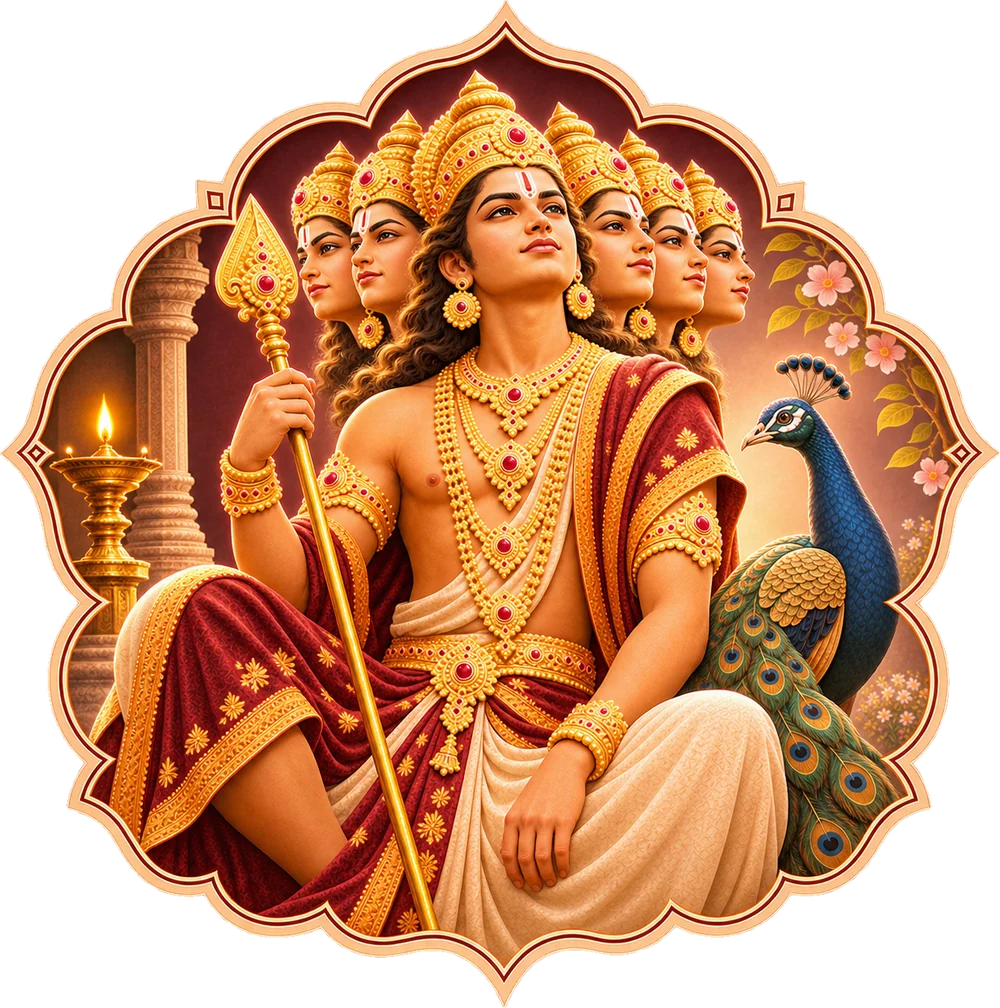
Murugan is a warrior god who defeats the demons and protects the gods. At the same time he counts as a teacher of the highest wisdom. He is usually shown as a handsome young man, sometimes with six faces and twelve arms.
He is the son of Shiva and Parvati and so the brother of Ganesha. In North India he is known as Kartikeya and stays rather in the background there. In South India, above all among Tamils, he is one of the most important gods of all. The tradition of his worship is called Kaumaram.
His story unites two sources. One is the Tamil god Murugan, who is already praised in the Sangam poetry of the first centuries CE. The other is the Sanskrit god Skanda of the epics and Puranas. Over time the two merged into one figure. The overview Hindu gods shows how he relates to the other gods.
What do the names Murugan, Kartikeya and Skanda mean?
Hardly any god has so many names. Each tells part of his story:
| Name | Language | Meaning |
|---|---|---|
| Murugan | Tamil | The beautiful, young one. Tamil murugu means beauty, youth, fragrance. |
| Kartikeya | Sanskrit | Son of the Krittikas, the six stars of the Pleiades who raised him. |
| Skanda | Sanskrit | The one who leaps forth, often linked to his birth from the spark. |
| Shanmukha | Sanskrit | The one with six faces. |
| Subrahmanya | Sanskrit | The one close to Brahman. A very common name in South India. |
| Kumara | Sanskrit | The youth who stays young for ever. |
How was Murugan born?
The texts tell of Murugan's birth in many versions. The core is always the same: a demon named Taraka threatens the gods. He can only be defeated by a son of Shiva. But Shiva sits in deep meditation.
In the Ramayana and parts of the Mahabharata, Agni, the fire god, carries Shiva's glowing power. It is so hot that he gives it to the river Ganga. The Ganga lays it down in a lake of reeds, the Saravana. There six children arise, who are nursed by the six Krittikas.
The Mahabharata knows further versions in which Agni himself is his father. In the Skanda Purana six sparks spring from Shiva's third eye. Parvati takes the six children in her arms, and they merge into one boy with six faces. In the 5th century the poet Kalidasa told the story leading up to this in the epic Kumarasambhava, “The Birth of Kumara”.
Even as a youth he becomes commander of the gods' army. He defeats Taraka and later, in the Tamil version, the demon Surapadman. According to legend, the two halves of the demon's split body become his peacock and the rooster on his banner.
What do the vel, peacock and rooster mean?
The most important symbol is the vel, a spear with a broad, leaf-shaped tip. According to Tamil tradition Murugan received it from his mother Parvati before the fight against Surapadman. The vel counts as the embodiment of her power, Shakti. That is why it is also called Shakti Vel.
The pointed, sharp blade stands for insight that cuts through ignorance. In many temples only the vel is worshipped, without a figure of the god. Further symbols:
- Peacockhis vehicle, an image of the conquered ego and its pride.
- Roosteron his banner, the call that ends the darkness.
- Six facesthe ability to see in all directions at once.
- ConsortsDevasena, daughter of Indra, and Valli, a girl from a hill tribe.
The story of the fruit of wisdom
Every child in Tamil Nadu knows one of the most loved stories. The sage Narada brings Shiva a special fruit. It is to go to the son who first circles the world. Murugan flies off on his peacock. Ganesha simply walks around his parents, because they are his world, and receives the fruit.
Disappointed, Murugan withdraws to a mountain. His parents follow him and say: pazham nī, “you yourself are the fruit”. According to tradition the place Palani got its name from this.
A second story tells how Murugan himself becomes a teacher. He asks Brahma about the meaning of the syllable Om, and Brahma has no answer. In the end Murugan explains it even to Shiva. That is why in Swamimalai he is called Swaminatha, “teacher of the Lord”.
Stories about Murugan to read
You can read these stories about Murugan in full here. Each has its own page with its meaning and where it stands in the scriptures.
- Murugan and Surapadmansix sparks become six children and then one god with six faces. He defeats the demon Surapadman. Read the whole story
- Murugan and Omthe creator Brahma cannot explain the syllable Om. The young Murugan can and becomes his father's teacher. Read the whole story
- The race around the worldtwo brothers are to circle the world. One flies off, the other walks around his parents. Read the whole story
Murugan's temples and his mantra
In Tamil Nadu there are six especially holy temples for him, the Arupadai Veedu: Thiruparankundram, Thiruchendur, Palani, Swamimalai, Thiruthani and Pazhamudircholai. Many believers make the pilgrimage to all six in the course of their lives. The Batu Caves in Malaysia with their huge golden statue also draw great streams of pilgrims. In Sri Lanka, Hindus, Buddhists and Muslims visit his shrine at Kataragama together.
His best-known mantra has six syllables, matching his six faces. It names him after the lake of reeds in which he was born:
Om, the one born in the lake of reeds.
| Word | Say it like | Meaning |
|---|---|---|
| oṃ | om | the sacred syllable |
| śaravaṇa | sha-ra-va-na | reed thicket, the lake in which he arose |
| bhava | bha-va | born, arisen from |
In Tamil the mantra is pronounced “Om Saravanabhava”. The call “Muruganukku Arohara”, a shout of joy at processions, is also popular.
When is Murugan celebrated?
The best-known festival is Thaipusam in the Tamil month of Thai, usually in January or February. Believers then carry a kavadi, a decorated frame, to the temple as an offering. Some fast for weeks beforehand. In Malaysia and Singapore Thaipusam is a great public festival.
Skanda Shashti follows in October or November. For six days believers recall the victory over Surapadman. The high point is the drama Soorasamharam on the beach at Thiruchendur.
If Murugan speaks to you, begin with his six-syllable mantra and the story of the fruit. Both link wisdom and devotion in a way that even children understand. From here the path leads easily to his parents Shiva and Parvati.
Frequently asked questions
Who is Murugan?
Murugan is the god of victory and wisdom, son of Shiva and Parvati. In the north he is called Kartikeya or Skanda.
Is Murugan the same as Kartikeya?
Yes. Murugan is the Tamil name, Kartikeya and Skanda are Sanskrit names. Over time the two traditions merged into one god.
Why does Murugan have six faces?
He arose as six children who were raised by the six Krittikas and united into one by Parvati. The six faces also stand for seeing in all directions.
What is the vel?
The vel is Murugan's spear. It counts as a gift of his mother Parvati and as a sign of the divine power Shakti.
When is Thaipusam?
Thaipusam falls in the Tamil month of Thai, usually in January or February, on the day of the lunar mansion Pusam.
Is Murugan married?
In South India he has two consorts, Devasena and Valli. In parts of North India, by contrast, he counts as unmarried.