




What is the Trimurti?
The Trimurti is the triad of the great gods in Hinduism. Each of them stands for a task in the great cycle of the world. Together they describe how everything arises, lasts for a while and passes away again.
The triad itself is no separate deity. It is a model of thought that puts three figures into an order. In practice most Hindus worship one of the three, or the goddess, as the highest reality. The other gods are respected but stay in the background. The page Hindu gods gives an overview.
Three forms, threefold form.
| Word | Say it like | Meaning |
|---|---|---|
| tri | tri | three |
| mūrti | moor-ti, long u | form, embodiment, also the image of a god in the temple |
Brahma, Vishnu and Shiva: who does what?
Each of the three gods has a clear role, a consort and a mount. The table shows them at a glance.
| God | Task | Consort | Mount |
|---|---|---|---|
| Brahma | creation | Saraswati | goose (Hamsa) |
| Vishnu | preservation | Lakshmi | the eagle Garuda |
| Shiva | dissolution | Parvati | the bull Nandi |
Brahma shapes the world at the beginning of each cycle. Vishnu keeps it in balance and comes as an avatar when it is in danger. Shiva ends it so that a new cycle can begin. So dissolution here is a necessary part of the whole.
Where does the idea of the Trimurti come from?
The Vedas do not yet have this triad. Brahma, Vishnu and Rudra-Shiva appear there separately and with different rank. An early approach is found in the Maitri Upanishad. It names Brahma, Vishnu and Rudra as forms of the one Brahman and assigns them to the three gunas.
The idea was worked out in the age of the Puranas, in the first millennium CE. Around the 5th century the poet Kalidasa describes it in his epic Kumarasambhava. There the one divine form divides threefold, and none of the three stands permanently above the others.
This one form divided itself threefold. Who is first and who is later changes among the three.
Kalidasa, Kumarasambhava 7.44, my own translation
What do the three gunas have to do with the Trimurti?
A common reading links the three gods with the three gunas, the basic forces of nature. This assignment already appears in the Maitri Upanishad and returns in the Puranas.
- Brahma and rajasRajas is movement and drive. Without it nothing new arises.
- Vishnu and sattvaSattva is clarity and balance. It keeps what exists in order.
- Shiva and tamasTamas is heaviness and rest. It brings everything to a standstill again.
The article The 3 gunas explains more about these three forces. The image helps in everyday life: every day, every project and every relationship knows a beginning, a duration and a farewell.
In the tradition the sacred syllable Om is also regarded as an image of the triad. Later texts assign its three sounds A, U and M to the three gods. The article Om meaning explains more.
How do the traditions see the Trimurti?
The great currents of Hinduism each read the triad from their own point of view. For each, one of the gods is more than a third of the whole.
- VaishnavismVishnu is the highest god. Brahma arises from the lotus of his navel, and Shiva acts on his behalf.
- ShaivismShiva carries out all the tasks himself. The tradition names five acts: creating, preserving, dissolving, concealing and granting grace.
- ShaktismThe goddess stands above all three. She is matched by a female triad, the Tridevi of Saraswati, Lakshmi and Parvati.
- Smarta traditionThe gods are regarded as equal forms of the one Brahman. You may choose any of them as your personal deity.
For Hindus this variety is a matter of course. They worship the one divine in the form that is close to them and respect the others.
How is the Trimurti depicted?
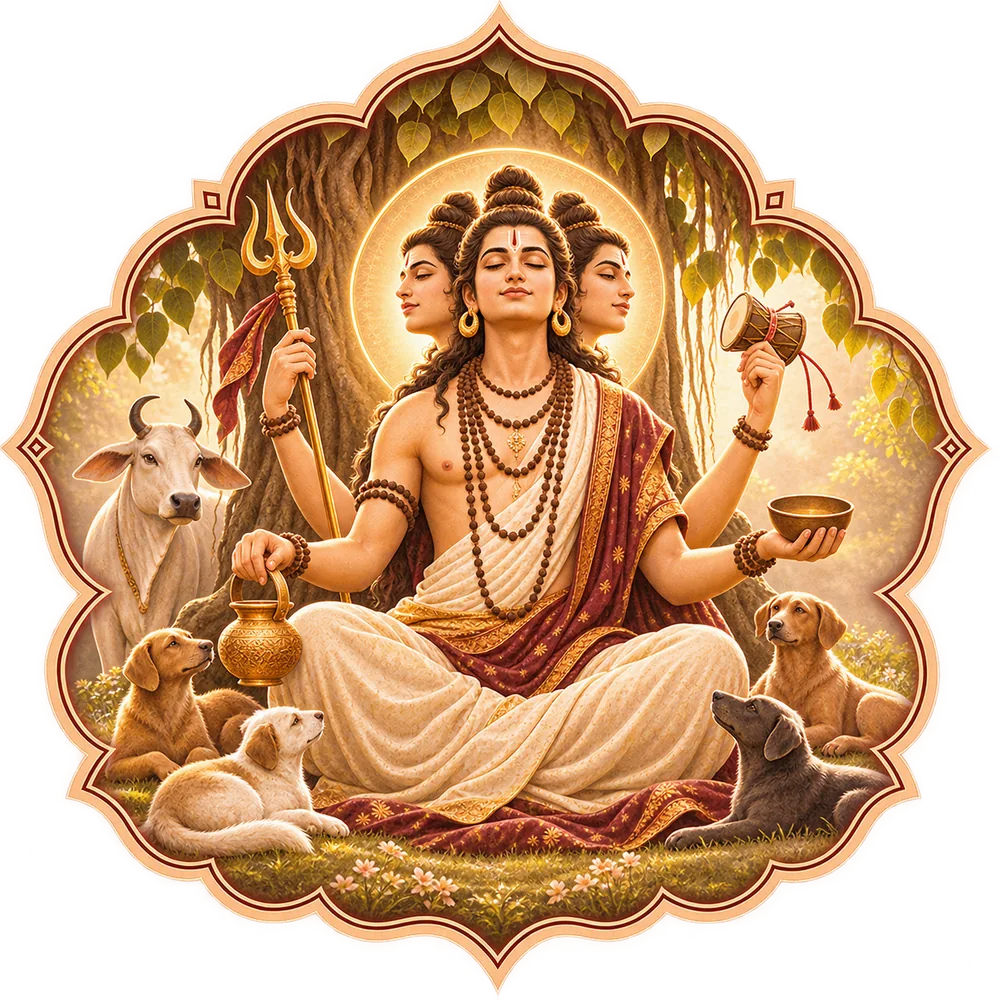
Images that show all three gods in one figure are rare. More often they stand side by side, for example on temple reliefs. Well known is Dattatreya, a sage with three heads who is regarded as an embodiment of the Trimurti. According to legend he is the son of the sage Atri and his wife Anasuya.
The famous three-headed figure in the caves of Elephanta near Mumbai is often called “Trimurti”. According to current research, however, it shows three faces of Shiva, the Maheshamurti. That too is typical: from the Shaiva point of view Shiva carries all three tasks within himself.
Is the Trimurti a trinity?
The Trimurti is sometimes called the “Hindu trinity”. The comparison is weak, though. The Christian Trinity describes three persons of one God with the same essence. The Trimurti stands for three tasks in the course of the world, embodied by three gods whose rank differs by tradition.
The only thing the two ideas share is the thought that the divine can show itself in more than one form. So if you want to understand Hinduism, it is best to read the Trimurti from its own texts.
If you want to go further, read next about the descents of Vishnu. The 10 avatars of Vishnu show how the preserver steps into the world. That way the abstract triad becomes a series of living stories.
Frequently asked questions
What does Trimurti mean?
Trimurti means “three forms”. It refers to Brahma, Vishnu and Shiva as creator, preserver and dissolver of the world.
Who belongs to the Trimurti?
Brahma, Vishnu and Shiva belong to the Trimurti. Their consorts Saraswati, Lakshmi and Parvati form the Tridevi.
Is the Trimurti a trinity?
Only very roughly. The Trimurti describes three tasks and three gods whose rank is seen differently depending on the tradition.
Is the Trimurti worshipped?
Hardly as a group. Hindus usually worship one of the gods or the goddess. An exception is Dattatreya, who unites the three in himself.
Who is the highest god of the Trimurti?
That depends on the tradition. For Vaishnavas it is Vishnu, for Shaivas Shiva; for Shaktas the goddess stands above all three.