




Who is Ganesha?
Ganesha is the god with whom almost everything begins. Before a puja, a wedding, an exam or moving into a new house, Hindus call on him first. He counts as Vighneshvara, “lord of obstacles”. He can remove obstacles, but he can also put them in the way when an undertaking is not good.
Ganesha is the son of Shiva and Parvati. His brother is Murugan, also called Kartikeya. In North India Murugan usually counts as the elder, in South India often Ganesha. You will find more about his mother and other goddesses under Hindu goddesses.
He is worshipped by almost every current of Hinduism. Shaivas, Vaishnavas and Shaktas alike begin their rituals with him. For the Ganapatyas he is even the highest deity. Their most important texts are the Ganesha Purana and the Mudgala Purana.
He is known outside India too, for example in Nepal, Thailand and Indonesia. In Japan he is worshipped as Kangiten. He also has his place in Jainism and in parts of Buddhism. The overview Hindu gods shows how he relates to the other deities.
What does the name Ganesha mean?
The name is made up of gaṇa and īśa. Gaṇa means host or group, referring to Shiva's followers. Īśa means lord. So Ganesha is the “lord of the hosts”. The name Ganapati means the same.
The Rigveda already knows the address gaṇapati. Verse 2.23.1 begins with gaṇānāṃ tvā gaṇapatiṃ havāmahe, “you, lord of the hosts, we call upon”. Originally it was addressed to Brihaspati, the lord of prayer. Today it is recited in many rituals for Ganesha. The elephant-headed god himself appears clearly in texts and images only from around the 4th to 5th century CE.
Further names describe his form and role:
- Vinayakathe leader, the guide.
- Ekadantathe one with one tusk.
- Lambodarathe one with the big belly.
- Vighnahartawho removes obstacles.
- Gajananathe one with the elephant face.
Ganesha symbolism: what each detail means
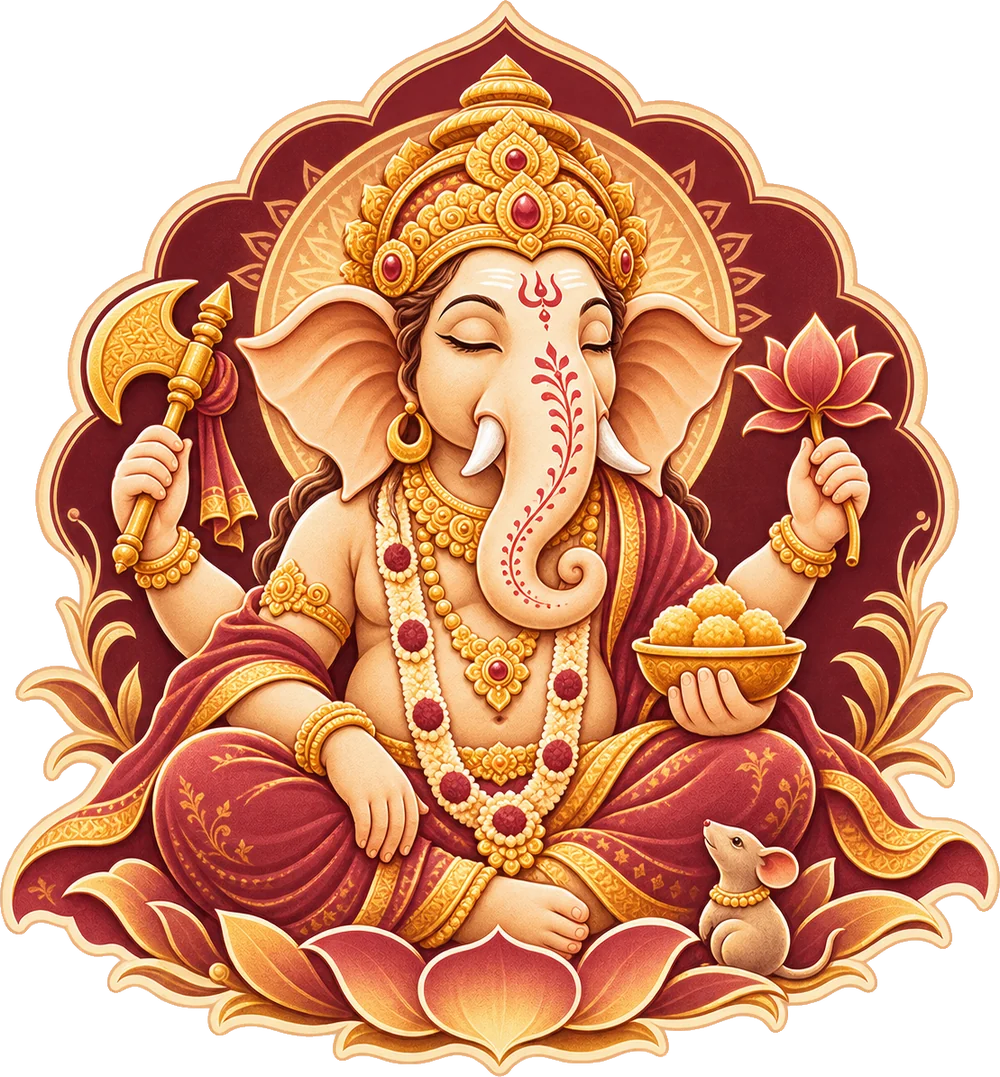
Hardly any image of a god is so rich in meaning. The table shows the best-known elements of Ganesha's symbolism and their common reading.
| Symbol | Meaning |
|---|---|
| Elephant head | Wisdom, memory and the strength to clear paths through dense forest. |
| Large ears | Listening well, taking in a lot. |
| Broken tusk | Readiness to sacrifice. According to a legend he wrote the Mahabharata with it. |
| Big belly | He takes in the good and the hard and digests it. |
| Modaka (sweet dumplings) | The sweetness of insight, his favourite food. |
| Axe and noose | He cuts through bonds and draws seekers to him. |
| Raised hand | Abhaya mudra, the gesture: do not fear. |
| Mouse as vehicle | Even the smallest serves him. It also stands for desire, which he steers. |
Why does Ganesha have an elephant head?
The best-known answer is in the Shiva Purana. Parvati forms a son from the paste she washes with and posts him as guard at her door. When Shiva comes home, the boy refuses him entry. Shiva does not know him and cuts off his head in the fight.
Parvati is inconsolable and threatens to destroy the world. Shiva has the head of the first creature his servants find brought to him. It is an elephant. Shiva sets the head in place and brings the boy back to life. He makes him leader of his hosts and decrees that he be worshipped before all other gods.
Other texts tell it differently. In the Brahmavaivarta Purana he loses his head through the gaze of the planet god Shani. Such variants are typical of the Puranas. Every region and tradition has kept its own version.
Which stories are told about Ganesha?
Besides the story of his head, families in India especially like to tell these four:
- The race around the worldShiva and Parvati promise a special fruit to the son who first circles the world. Kartikeya flies off on his peacock. Ganesha simply walks around his parents, because they are his world. He wins. Read the whole story
- The scribe of the Mahabharatathe sage Vyasa dictates the epic, Ganesha writes. His condition: Vyasa may never falter. This episode appears only in some of the manuscripts. That Ganesha broke off his tusk for it is told only in later folk tradition. Read the whole story
- The feast at Kubera'sthe rich Kubera invites Ganesha to show off his wealth. Ganesha eats everything and is still hungry. Only a handful of rice that Shiva lovingly offers him fills him up. Read the whole story
- The moon and the curseafter a feast Ganesha stumbles, and the moon laughs at him. He curses the moon. That is why people still say you should not look at the moon on the night of Ganesh Chaturthi. Read the whole story
- Ganesha's elephant headParvati creates a son as a guard. Shiva does not know him, and a fight follows. Read the whole story
The stories show the same attitude again and again. With Ganesha, cleverness, humility and loyalty count for more than strength, speed or wealth. That makes him a model for learners and students.
How do you set up a Ganesha figure?
Many people have a Ganesha figure at home, outside India too. The tradition knows a few simple rules for this. They come from folk devotion and from Vastu, the Indian teaching on building and dwelling.
- Choose a placea clean, quiet spot in the prayer area or near the entrance. According to Vastu the north-east counts as favourable.
- Avoid the bathroom and bedroomHindus traditionally do not place images of gods there.
- Look at the trunkfor the home most people choose a figure whose trunk curves to his left.
- Greet him dailya flower, a light or a sweet are enough, with a short verse.
A trunk curving to his right counts as especially powerful. According to folk tradition, however, such a figure demands strict, regular worship. This is how he is shown in the well-known Siddhivinayak temple in Mumbai, for example.
Which mantras belong to Ganesha?
The best-known Ganesha mantra is Om Gam Ganapataye Namaha with the seed syllable gaṃ. It is explained word by word in the article Om Gam Ganapataye Namaha. Besides that, many sing this short verse before every undertaking:
You with the curved trunk and the great body, radiant as ten million suns: O god, make all my undertakings free of obstacles, always.
| Word | Say it like | Meaning |
|---|---|---|
| vakratuṇḍa | vak-ra-tun-da | you with the curved trunk |
| mahākāya | ma-haa-kaa-ya | you with the great body |
| sūryakoṭi samaprabha | soor-ya-ko-ti sa-ma-pra-bha | radiant as ten million suns |
| nirvighnaṃ kuru | nir-vig-nam ku-ru | make free of obstacles |
| sarvakāryeṣu sarvadā | sar-va-kaar-yay-shu sar-va-daa | in all undertakings, always |
The verse is often sung before studying, before concerts and before kirtan evenings. It is short enough to learn by heart in a few days.
Whoever wants to go deeper finds a longer hymn in the Ganapati Atharvashirsha, which praises Ganesha as the Absolute. It probably arose in the 16th or 17th century and is recited especially in Maharashtra.
When is Ganesha celebrated?
The biggest festival is Ganesh Chaturthi, his birthday in August or September. It usually lasts ten days. Families and neighbourhoods set up Ganesha figures, sing and offer modakas. At the end the figures are immersed in a river, lake or the sea.
The freedom fighter Bal Gangadhar Tilak shaped it into a great public festival from 1893 in Pune. Today it is celebrated especially in Maharashtra, Goa and Karnataka with large processions. Besides this, every fourth lunar day after full moon is dedicated to him, Sankashti Chaturthi.
If you want to bring Ganesha into your practice, begin every session with his name. A single verse before singing is enough. From him you gradually get to know the gods he introduces in the tradition, above all his parents Shiva and Parvati.
Frequently asked questions
What does Ganesha stand for?
Ganesha stands for good beginnings, wisdom and the removal of obstacles. That is why he is called on first before almost every ritual and undertaking.
Why does Ganesha have only one tusk?
The traditions tell it in different ways. According to a well-known legend he broke it off to write down the Mahabharata with it.
Why does Ganesha ride a mouse?
The mouse shows that even the smallest serves him. It also stands for desires, which he holds in check.
Is Ganesha married?
That depends on the region. In North and West India Riddhi and Siddhi count as his consorts, and the Shiva Purana names Siddhi and Buddhi. In large parts of South India he counts as unmarried.
Which mantra is for Ganesha?
The best known is Om Gam Ganapataye Namaha. The verse “Vakratunda Mahakaya” before new undertakings is also popular.
Should the trunk point left or right?
For the home most choose a trunk curving to Ganesha's left. A trunk curving right counts as very powerful and, according to tradition, demands strict worship.