




Who is Agni?
Agni is the Vedic god of fire. His name is the Sanskrit word for fire and is related to the Latin ignis. He is the fire in the hearth, on the sacrificial altar, in lightning and in the sun.
Fire stands at the centre of Vedic religion. Without fire there is no offering, and without offering no connection with the gods. That is why he counts as the mediator who joins heaven and earth.
In later mythology he lost importance compared with gods such as Vishnu and Shiva. In ritual, however, he stayed indispensable. The overview Hindu gods shows how he fits into the whole pantheon.
Agni in the Rigveda: the first verse
The Rigveda, the oldest text of Hinduism, begins with a hymn to the fire god. The first verse (Rigveda 1.1.1) calls him the household priest and the divine priest of the offering. This opening shows how central fire was for the Vedic poets.
Around 200 hymns are dedicated to him. Only Indra, the king of the gods, has more. Some hymns also call on the two together as a pair of gods.
I praise Agni, the household priest, the god and priest of the offering, the caller who grants the most treasures.
| Word | Say it like | Meaning |
|---|---|---|
| agnim īḷe | ag-nim ee-lay | I praise Agni |
| purohitam | pu-ro-hi-tam | the one placed in front, the household priest |
| yajñasya devam ṛtvijam | yag-nyas-ya day-vam rit-vi-jam | the god and priest of the offering |
| hotāram | ho-taa-ram | the caller who summons the gods |
| ratnadhātamam | rat-na-dhaa-ta-mam | the greatest giver of treasures |
The translation is my own and stays close to the wording. The ḷ in īḷe is a special sound of the Rigveda: an l with the tongue curled back.
Agni's tasks: messenger, priest, witness
In the Vedas the fire god has several roles. All of them turn on the connection between humans and gods.
The Vedic poets also describe his birth. The sacrificial fire was kindled by rubbing two pieces of wood, the araṇi. That is why the god is called “son of strength”. Because he is born anew at every ritual, the hymns also call him the “youngest”. His tasks can be summed up like this:
- Messenger (dūta)he carries the offerings in the smoke to the gods and brings the gods to the offering.
- Priest (hotṛ)he calls the gods, like a human priest.
- Jatavedas“who knows all creatures”. He sees what people do.
- Vaishvanara“who belongs to all people”. The fire in every house and in every body.
- Witnesspromises made before the fire count as sacred.
In the Vedic view fire exists in all three worlds: as fire on earth, as lightning in the air and as the sun in the sky.
Stories about Agni to read
You can read these stories about Agni in full here. Each has its own page with its meaning and where it stands in the scriptures.
- Agni hidesthe fire god no longer wants to be the messenger of the gods and hides in the water. The gods search for him. Read the whole story
- Vayu and the blade of grasswind and fire think they are all-powerful. A strange being sets a blade of grass before them. Read the whole story
How is Agni depicted?
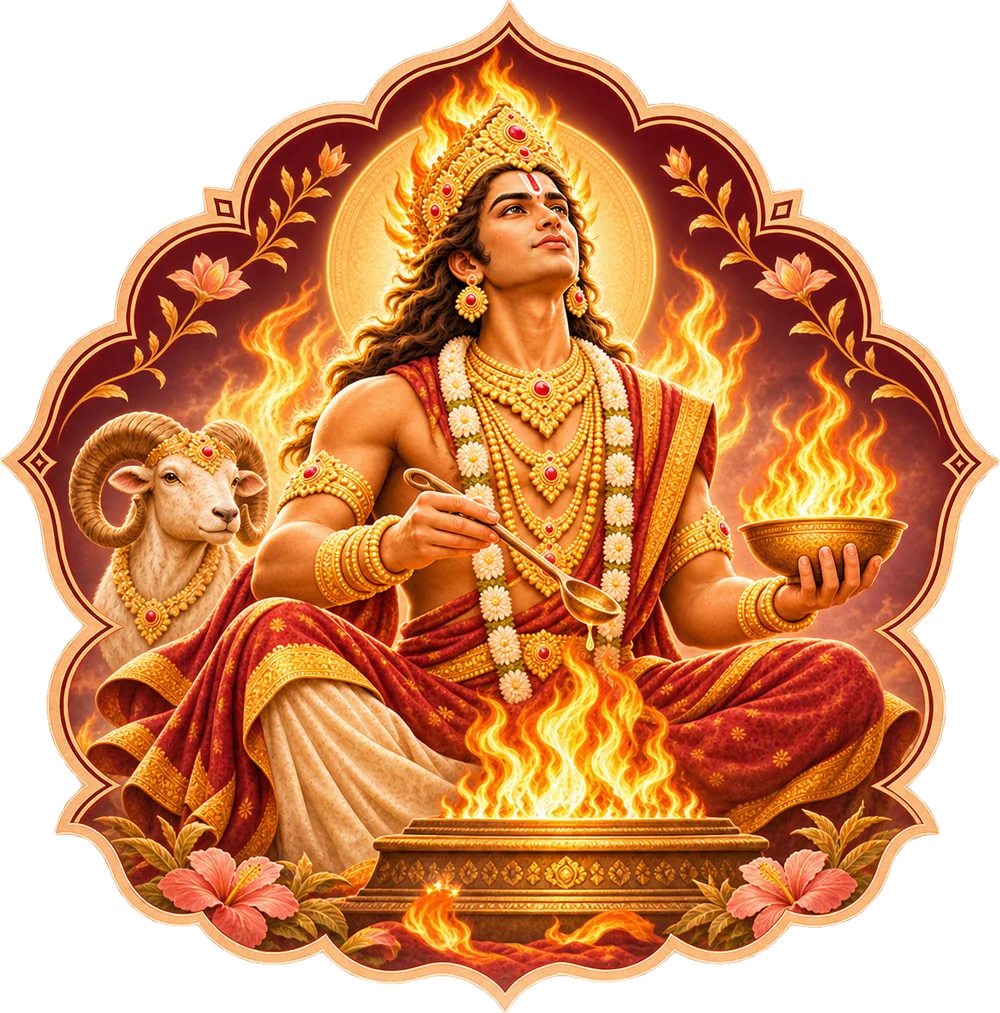
In images the god usually appears red, with two heads and seven tongues of flame. He rides a ram. Often he holds a sacrificial ladle or a torch.
The two heads are often read as the two most important sacrificial fires. The seven tongues are already known to the Mundaka Upanishad (1.2.4), which lists their names. As one of the guardians of the directions he watches over the south-east.
His consort is Svaha. Her name is called into the fire with every offering: “svāhā”. So every ritual also celebrates her bond with the fire god.
Agni and the birth of Murugan
Without the fire god the war god Skanda would not have been born. In South India this son of Shiva is much loved as Murugan. The Mahabharata and the Ramayana tell the story in different versions.
Shiva's glowing seed was so powerful that no one could carry it. Fire took it up, but the heat became too great even for him. He handed it to Ganga, who laid it down in a forest of reeds. There the child was born and nursed by six star goddesses, the Krittikas. Hence his name Kartikeya.
Agni in ritual today
The fire god is still present at every important event in life. Fire links everyday life with the old Vedic rituals.
| Ritual | Role of the fire |
|---|---|
| Homa or havan | Gifts such as ghee and rice go into the fire with “svāhā” |
| Wedding | The couple walks around the fire, which counts as witness |
| Cremation | The fire carries the dead onward |
| Aarti | A circling lamp as light for the deity |
| Agnihotra | Daily offering at sunrise and sunset |
What Agni can tell you today
Fire transforms. It makes food edible, gold pure and wood into light. In Ayurveda the power of digestion is also called agni. In yoga practice the inner fire, tapas, stands for discipline and endurance.
Whoever knows the fire god also understands the other Vedic gods better. Read next about Indra, the king of the gods, or about Surya, the sun. Step by step the picture of India's oldest world of gods comes together.
Frequently asked questions
Who is Agni in Hinduism?
He is the god of fire. He counts as the messenger between humans and gods and carries the offerings to them.
What does the word agni mean?
It is the Sanskrit word for fire. It is related to the Latin ignis.
Why does the Rigveda begin with Agni?
Fire was the centre of the Vedic offering. Without fire there was no connection with the gods, so he stands at the beginning.
What is Agni's vehicle?
He rides a ram and is usually shown red, with two heads and seven tongues of flame.
What does svaha mean?
Svaha is the call with which gifts are placed into the fire. As a goddess, Svaha also counts as the fire god's consort.