




Who is Vayu?
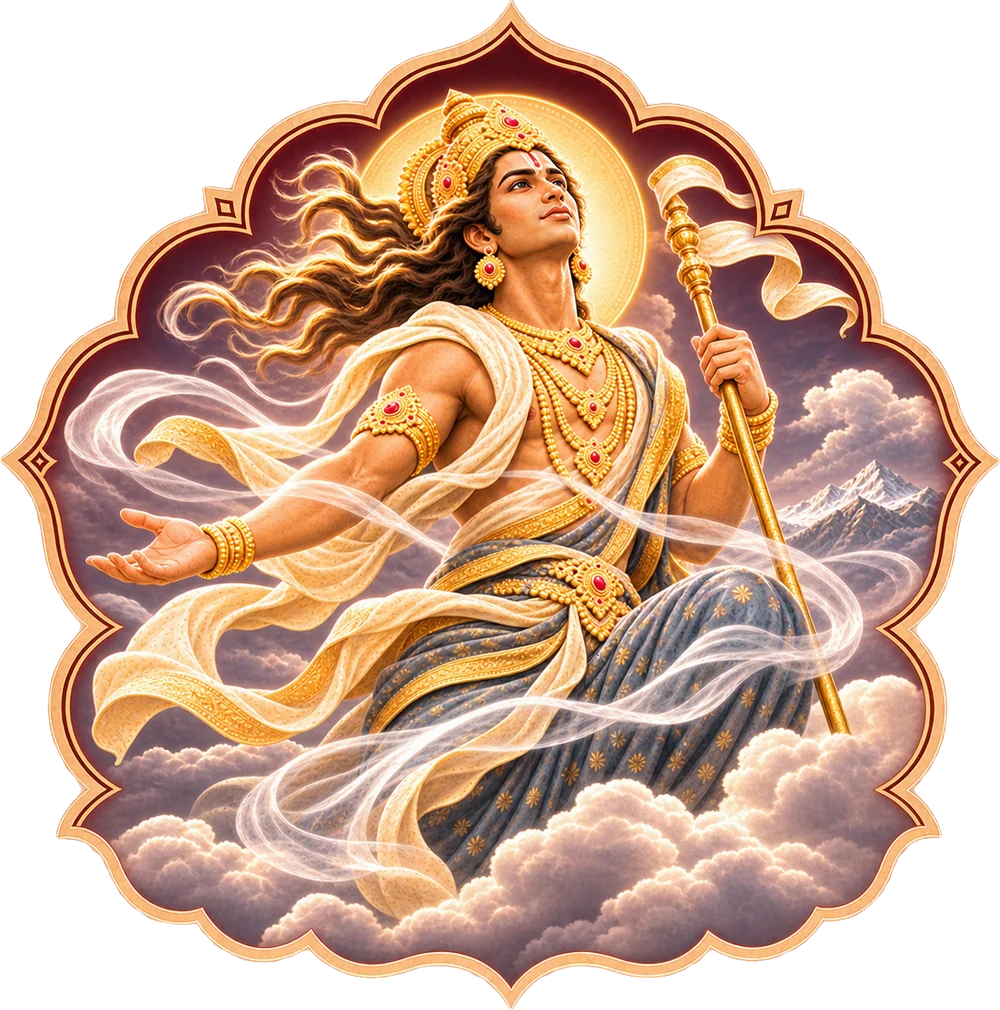
Vayu is the god of wind, air and breath. His name comes from the Sanskrit root vā, “to blow”. He is one of the oldest gods of the Vedas and is still present today in prayers and yoga teachings.
In the Rigveda he is swift, strong and beautiful. He drives a chariot drawn by many horses and is often linked with Indra. Beside him stands Vata, a second form of the wind. Hymn 10.168 is dedicated to him.
According to the Purusha Sukta (Rigveda 10.90) the wind arose from the breath of the cosmic primordial being. So from the start the wind god is closely linked with breath. The overview Hindu gods shows how he fits into the whole world of the gods.
What does Vayu stand for in the Vedas?
In the Vedas he is regarded as the first to drink soma, the sacred offering drink. That is why at many sacrifices he receives the first share. It shows how highly he was respected.
He cleanses, moves and connects. The wind carries scents, clouds and sounds. So he also became a messenger between the worlds, like Agni, the fire.
In later texts he is one of the eight guardians of the directions, the Dikpalas. He guards the north-west and rides an antelope or gazelle. In his hand he holds a fluttering banner.
Father of Hanuman and Bhima
The wind god is the divine father of two great heroes. In the Ramayana it is Hanuman, in the Mahabharata Bhima. Both are famous for their strength and speed, qualities of the wind.
That is why Hanuman is also called Pavanaputra or Maruti, son of the wind. The Hanuman Chalisa calls him that too: “Anjaniputra Pavanasuta”, son of Anjani and of the wind. The Ramayana tells that as a child Hanuman took the sun for a fruit and leapt for it. Indra struck him on the jaw with his thunderbolt.
The angry wind god then withdrew, and on earth the air stood still. All beings suffered. Only when the gods showered Hanuman with blessings did the wind return.
In the Dvaita tradition of the philosopher Madhvacharya (13th century), Madhva himself is regarded as the third incarnation of the wind god, after Hanuman and Bhima.
Stories about Vayu to read
You can read these stories about Vayu in full here. Each has its own page with its meaning and where it appears in the scriptures.
- Vayu and the blade of grass: Wind and fire think they are almighty. A strange being lays a blade of grass before them. Read the whole story
Vayu and prana: the wind in the body
In the Upanishads the wind is moved inwards. What blows outside as wind is the breath in the body, prāṇa. That is why the wind god is closely linked with the life force.
The Brihadaranyaka and the Chandogya Upanishad tell a famous story. The senses argue over who is most important. One after another, speech, eye, ear and mind leave the body, and it lives on. When the breath is about to go, all of them are in distress. Then they realise: the breath is the most important.
Yoga teaching distinguishes five forms of prana, the vayus. Each has its own task in the body.
| Name | Area | Task |
|---|---|---|
| Prana | chest, head | breathing in, taking in |
| Apana | pelvis | eliminating, leading downwards |
| Samana | middle of the belly | digesting, balancing |
| Udana | throat, head | speech, leading upwards |
| Vyana | whole body | distributing, circulation |
The element air and the Vayu Purana
In the Indian teaching of the five elements, air is the second subtlest after space. The series is: space, air, fire, water, earth. Each element is assigned a sense, air the sense of touch. You feel the wind; you cannot see it.
The god also gave his name to one of the 18 great Puranas. Scholars regard the Vayu Purana as one of the older Puranas. According to tradition the wind god himself recited its content. It tells of creation, royal lineages and the worship of Shiva.
A mantra to Vayu
A well-known greeting to the wind god stands at the start of the Taittiriya Upanishad (1.1.1). It is still recited today in many Vedic schools at the beginning of lessons.
Salutation to you, Vayu. You alone are the visible Brahman.
| Word | Say it like | Meaning |
|---|---|---|
| namaste | na-mas-tay | salutation to you |
| vāyo | vaa-yo | O Vayu |
| tvam eva | tvam ay-va | you alone |
| pratyakṣam | prat-yak-sham | visible, directly perceptible |
| brahmāsi | brah-maa-si | are Brahman |
The thought behind it: the highest being, Brahman, is invisible. But you feel the wind and the breath at every moment. In them the divine becomes directly perceptible.
What the wind god shows you today
For people who practise yoga this god is close. Every breathing exercise, every pranayama, works with the power he embodies. In the traditional understanding, whoever breathes consciously honours the wind in their own body.
In Hinduism many forces of nature are regarded as divine. Water is worshipped as the river goddess Ganga, the heavenly bodies as the Navagraha, the nine planetary deities. When you look at these forces together, you understand why nature is regarded as sacred in India.
Frequently asked questions
Who is Vayu in Hinduism?
Vayu is the god of wind, air and breath. He is worshipped already in the Rigveda.
Is Vayu Hanuman’s father?
Yes. According to the Ramayana the wind god is Hanuman’s divine father. That is why Hanuman is also called Pavanaputra, son of the wind.
What is the difference between Vayu and prana?
Vayu is the wind and its god, prana the breath and the life force in the body. The Upanishads see both as the same power, outside and inside.
What are the five vayus?
The five vayus are prana, apana, samana, udana and vyana. In yoga teaching they are regarded as five movements of the life force.
Which direction does Vayu guard?
He is the guardian of the north-west. His mount is an antelope, often also described as a gazelle.