




Who is the goddess Ganga?
Ganga is the sacred river Ganges, revered as a goddess and as a mother. Many Hindus call her Gaṅgā Mā, Mother Ganga. She stands for purification, grace and the end of suffering.
The river rises in the Himalaya at the Gangotri glacier. It flows for about 2525 kilometres through North India and enters the Bay of Bengal in Bangladesh. Sacred cities such as Haridwar, Prayagraj and Varanasi lie on its banks.
For believers the water itself is the goddess. That is why they worship the river directly: with baths, flowers and lights. The page Hindu gods gives an overview of how forces of nature and other deities belong together.
How do you recognise Ganga?
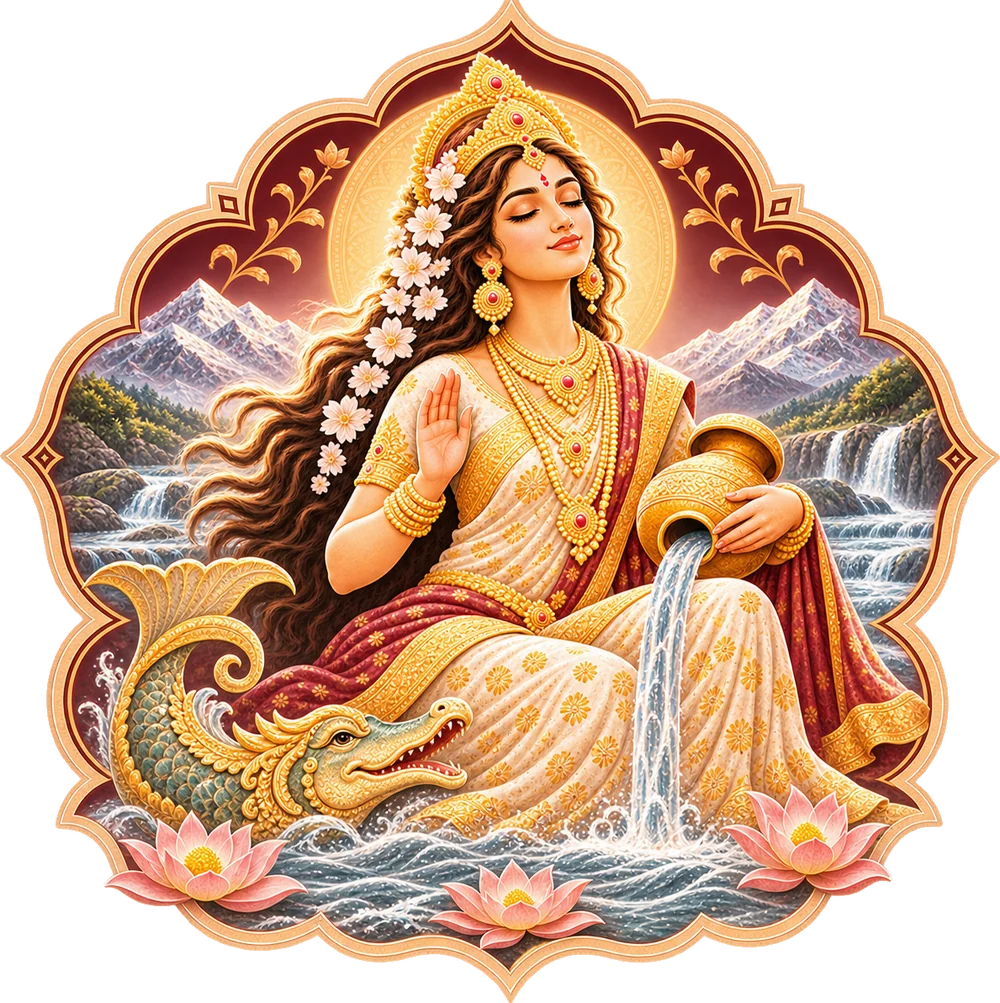
In images Ganga appears as a beautiful, fair woman standing on or riding a makara. The makara is a water creature, half crocodile, half fish. It counts as her vehicle.
In her hands she usually holds a water jar and a lotus. At temple gates Ganga and her sister Yamuna often stand as guardians. Whoever passes through is symbolically purified.
She is also often seen as a small figure in Shiva's topknot, with a jet of water springing from her. This Shiva is called Gaṅgādhara, “bearer of the Ganga”.
How Ganga came down from heaven
The best-known story is the descent of the Ganga to earth. The Ramayana tells it in its first book, the Bala Kanda. The Bhagavata Purana also hands it down.
- The curseKing Sagara had 60,000 sons. They insulted the sage Kapila and were burned to ashes by his gaze.
- The austerityonly the water of the heavenly Ganga could free their souls. Their descendant Bhagiratha practised strict austerity for many years until Brahma agreed.
- Shiva's helpthe force of the river would have destroyed the earth. Shiva caught Ganga in his matted hair and let her flow down slowly.
- The releaseGanga followed Bhagiratha across the land to the ashes of the ancestors. Her water freed the souls of Sagara's sons.
The source river of the Ganga is still named Bhagirathi after the king. In India a great effort is proverbially called “Bhagiratha's labour”.
Stories about Ganga to read
You can read these stories about Ganga in full here. Each has its own page with its meaning and where it stands in the scriptures.
- Ganga and Shantanua king marries a stranger by the river. He may never ask why she carries her children into the water. Read the whole story
- The descent of the GangaKing Bhagiratha brings the heavenly river to earth. Shiva catches it in his hair. Read the whole story
Ganga in the Vedas and the Mahabharata
In the Rigveda Ganga is named in the river hymn 10.75, first in a series of rivers. There she is still one river among many. Her importance grew only in later centuries.
In the Mahabharata Ganga is the wife of King Shantanu and the mother of Bhishma, one of the great heroes of the epic. She bore eight sons, demigods called the Vasus, who were under a curse. Seven she gave to the water right after birth in order to free them. Shantanu saved the eighth, Bhishma.
Bathing, rituals and the Kumbh Mela
A bath in the Ganga counts as purifying for body and soul. Many people take Ganges water, Gaṅgājal, home in bottles. It is used in rituals and placed on the lips of the dying.
In Varanasi the dead are cremated on the bank and their ashes given to the river. According to belief, whoever dies here attains liberation. Every evening priests celebrate the Ganga Aarti with large oil lamps at the ghats of Varanasi, Haridwar and Rishikesh.
The Kumbh Mela is one of the largest religious gatherings in the world. It takes place in turn at four sites, among them Prayagraj. There the Ganga, the Yamuna and, according to tradition, the invisible Saraswati meet.
Ganga Dussehra and a mantra
The festival Ganga Dussehra recalls the descent of the goddess to earth. It falls on the tenth day of the waxing moon in the month of Jyeshtha, usually in May or June. Then especially many people bathe in the river.
A well-known verse calls on the seven sacred rivers of India. It is spoken over a vessel of water before a puja, so that the water becomes as pure as the Ganga.
O Ganga, Yamuna, Godavari, Saraswati, Narmada, Sindhu and Kaveri: be present in this water.
| Word | Say it like | Meaning |
|---|---|---|
| gaṅge ca yamune caiva | gan-gay cha ya-mu-nay chai-va | O Ganga and Yamuna |
| godāvari sarasvati | go-daa-va-ri sa-ras-va-ti | O Godavari, O Saraswati |
| narmade sindhu kāveri | nar-ma-day sin-dhu kaa-vay-ri | O Narmada, Sindhu, Kaveri |
| jale'smin | ja-lays-min | in this water |
| sannidhiṃ kuru | san-ni-dhim ku-ru | make your presence |
Ganga today: faith and environmental protection
Today the river is heavily polluted by sewage, industry and the many people on its banks. For many believers this is a contradiction: the goddess counts as pure, and yet the river suffers. In 2014 the Indian government launched the Namami Gange programme to clean the river.
Ganga shows how closely nature and the divine are linked in Hinduism. The wind is also worshipped as a god, as Vayu, and the heavenly bodies as the Navagraha. When you get to know these nature deities, you understand why Hindus regard rivers, mountains and sky as sacred.
Frequently asked questions
Who is the goddess Ganga?
Ganga is the goddess of the river Ganges. Hindus revere her as a mother whose water cleanses from guilt and suffering.
Why does Shiva carry Ganga in his hair?
When Ganga came down from heaven, her force would have destroyed the earth. Shiva caught her in his hair and let her flow down slowly.
What is Ganga's vehicle?
Her vehicle is the makara, a water creature that resembles a crocodile.
What is Ganga Dussehra?
Ganga Dussehra is the festival of the Ganga's descent to earth. It falls in the month of Jyeshtha, usually in May or June.
Why is the Ganges sacred?
According to belief the river is the goddess Ganga herself. A bath in her water counts as purifying, and whoever dies in Varanasi is said to attain liberation.