




Who is Hanuman?
Hanuman is one of the central figures of the Ramayana, the great epic of Rama and Sita. He belongs to the Vanaras, a people of monkey-like beings in the forest of Kishkindha. As minister of the monkey king Sugriva he meets Rama and becomes his most devoted servant.
His mother is Anjana, which is why he is also called Anjaneya. Kesari, a leader of the Vanaras, counts as his father. His divine father, however, is Vayu, the wind god. Hence his speed and his gift of flight. In Shaiva texts such as the Shiva Purana he also counts as an embodiment of Shiva.
He is one of the Chiranjivis, the immortals. According to tradition he still lives wherever Rama's name is sung. Temples to him stand all over India, often at the edge of a village or on highways. There travellers ask him for protection before they move on. The overview Hindu gods shows how he relates to the other gods.
What does the name Hanuman mean?
The name comes from hanu, “jaw”. Hanumān means “the one with the (striking) jaw”. Behind it lies a childhood story from the Ramayana. The child takes the rising sun for a ripe fruit and leaps up towards it. Indra, king of the gods, strikes him on the jaw with his thunderbolt.
Then the wind god Vayu withdraws in anger, and all beings gasp for air. To appease him, the gods give the child special powers. Further names describe his qualities:
- Marutison of Maruta, the wind.
- Pavanaputrason of the wind.
- Bajrangbalithe strong one with limbs as hard as the thunderbolt.
- Mahavirathe great hero.
- RamadutaRama's messenger.
What does the Ramayana tell about Hanuman?
Most of these stories are in Valmiki's Ramayana. The fifth book, the Sundara Kanda, tells almost nothing but his deeds. Many families read it as a text of its own. The plot in brief:
- The meetingRama and his brother Lakshmana are searching the forest for the abducted Sita. The Vanara meets them and knows at once whom he wants to serve.
- The leap to Lankano one knows where Sita is. Rama's messenger grows to enormous size and leaps across the sea to the island of Lanka, the realm of the demon king Ravana.
- The ring for Sitahe finds Sita in a grove. As a sign he gives her Rama's ring and promises rescue.
- Lanka in flamesRavana's people set his tail on fire. He leaps across the roofs and sets the city ablaze.
- The mountain of herbsin the war Lakshmana is badly wounded. The son of the wind flies to the Himalaya, cannot find the medicinal herb and brings the whole mountain.
A later folk tale shows what defines him. The loyal servant tears open his chest, and Rama and Sita sit in his heart. This scene is not in Valmiki, yet it is one of the best-known images of him. The article Ramayana explains the whole plot.
Stories about Hanuman to read
You can read these stories about Hanuman in full here. Each has its own page with its meaning and where it stands in the scriptures.
- Hanuman and the sunlittle Hanuman takes the sun for a fruit and leaps up. Indra strikes him with the thunderbolt. Read the whole story
- Hanuman's leap to LankaHanuman leaps across the ocean, finds the abducted Sita and sets Ravana's city on fire. Read the whole story
- Hanuman and the Sanjivani mountainLakshmana lies dying. Hanuman is to fetch a herb from the Himalaya and brings the whole mountain. Read the whole story
- Rama in Hanuman's heartHanuman bites through a precious pearl necklace. When he is mocked, he opens his chest. Read the whole story
- Rama and Ravanaan army of monkeys and bears builds a bridge across the sea. Before Lanka the final battle begins. Read the whole story
How do you recognise Hanuman?
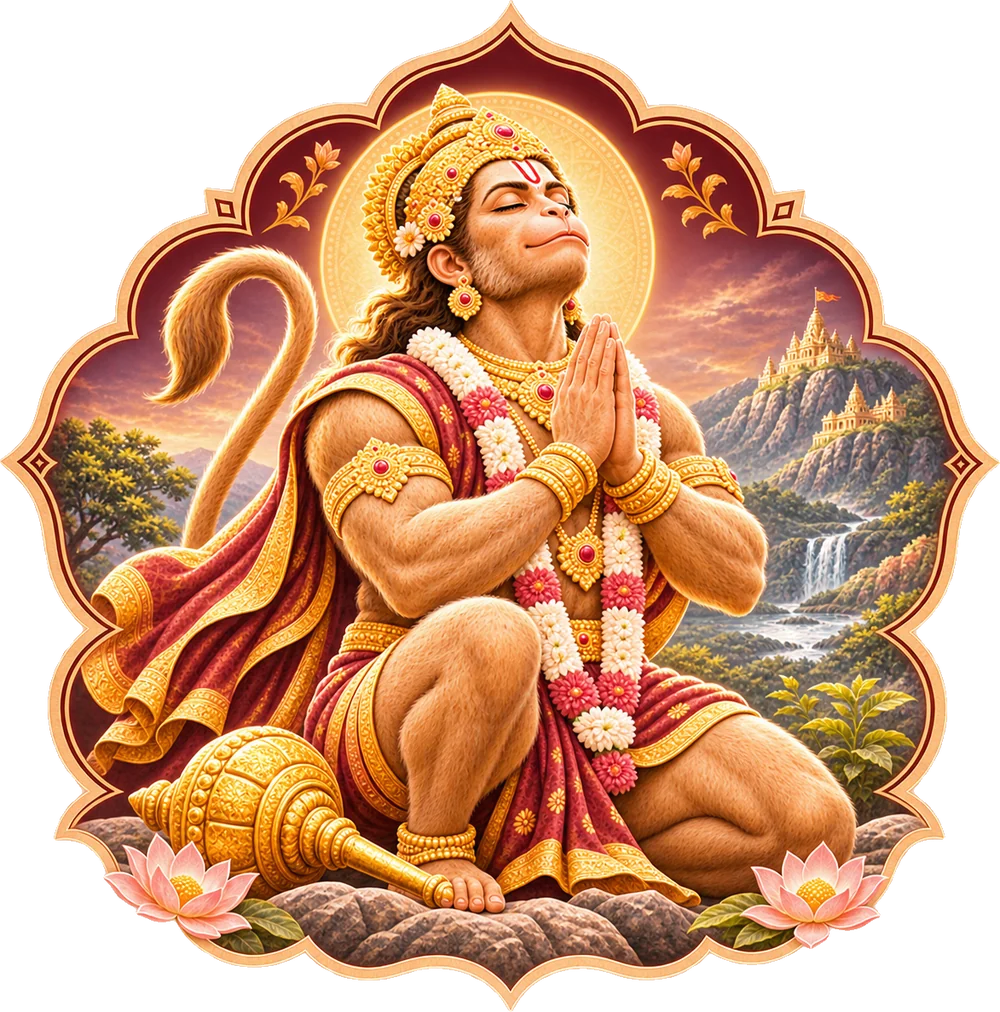
In pictures he usually appears in one of two postures. Either he kneels before Rama with folded hands, as a humble servant. Or he flies with the mountain in his hand, as a powerful hero. The table shows his most important symbols.
| Symbol | Meaning |
|---|---|
| Mace (gada) | Physical strength and protection from danger. |
| Mountain in his hand | Help without limits, from the story of the mountain of herbs. |
| Folded hands | Devotion and service, the posture of the perfect bhakta. |
| Orange-red colour | Sindoor, a red paste. According to a legend he covered himself with it out of love for Rama. |
| Long tail | His origin as a Vanara and the burning of Lanka. |
A special form is the Panchamukhi Hanuman with five faces. Besides his own he bears the faces of Narasimha, Garuda, Varaha and Hayagriva. According to a later legend he took this form to free Rama and Lakshmana from the underworld. Many families hang his picture above the front door for protection.
Hanuman counts as a brahmachari, a man who lives in celibacy. So he also stands for self-control and concentrated strength.
Hanuman in the Mahabharata and later texts
The Mahabharata knows Hanuman too. In the third book he meets his half-brother Bhima, also a son of the wind god. He lies old and weak across the path, and strong Bhima cannot even lift his tail. So Bhima learns humility. In the great war he sits on the banner of Arjuna's chariot.
Yet he owes his greatest popularity to the bhakti movement. In the 16th century the poet Tulsidas wrote the Ramcharitmanas, a version of the Ramayana in Awadhi. The Hanuman Chalisa, 40 verses about his deeds, is also attributed to him. Today it is one of the most sung prayers in India. You will find all the verses with translation in the article Hanuman Chalisa.
He is a hero in Southeast Asia as well. He appears in the Thai Ramakien and in Javanese shadow theatre. There he shows other sides: in the Ramakien he is playful and vain and has several wives. So the celibate servant is above all an image of Indian bhakti.
Which mantras belong to Hanuman?
Besides the Chalisa there is a short verse that many say before prayer. It comes from the Rama Raksha Stotra and describes him in a few words:
In him I take refuge: swift as thought, fast as the wind, master of his senses, wisest of the wise. He is the son of the wind, leader of the Vanaras, messenger of Rama.
| Word | Say it like | Meaning |
|---|---|---|
| manojavaṃ | ma-no-ja-vam | swift as thought |
| mārutatulyavegaṃ | maa-ru-ta-tul-ya-vay-gam | fast as the wind |
| jitendriyaṃ | ji-tayn-dri-yam | who has conquered his senses |
| vātātmajaṃ | vaa-taat-ma-jam | son of the wind |
| śrīrāmadūtaṃ | shree-raa-ma-doo-tam | messenger of Rama |
| śaraṇaṃ prapadye | sha-ra-nam pra-pad-yay | I take refuge |
An even shorter mantra is oṃ haṃ hanumate namaḥ, “Om, salutation to Hanuman”. It is well suited to japa with the mala.
Yet most singers begin with the Chalisa. Its verses retell the stories in this article in song form. In North India many children know it by heart long before they understand the meaning of every word.
What does Hanuman mean for practice?
For many practitioners he is the model of the bhakta, the devoted person. He has enormous powers but never uses them for himself. Everything he does, he does for Rama. In the tradition this is called dāsya, devotion as service, one of the nine forms of bhakti.
In yoga you may know him from the posture Hanumanasana, the splits. It recalls his great leap across the sea. Some teachers tell the story before the practice so that the posture gains meaning.
You can learn from him in daily life too. He does not hesitate long when help is needed. And when he cannot recognise the medicinal herb, he simply brings the whole mountain. That is why he is also called Sankat Mochan, “who frees from distress”. The Sankat Mochan temple in Varanasi is said to go back to the poet Tulsidas.
When is Hanuman celebrated?
His birthday is called Hanuman Jayanti. In North India it falls on the full moon of the month of Chaitra, that is March or April. In South India many celebrate him on other dates, in Tamil Nadu for example in December or January. Believers fast, visit temples and often recite the Chalisa many times in a row.
Tuesday and Saturday count as his days. Then many people bring sindoor, oil and sweets to his temples. On Saturday he is also called on to avert difficulties caused by the planet Saturn.
If you want to come closer to him, first read the Sundara Kanda in a good retelling. Then learn a few verses of the Chalisa. With each verse it becomes clearer why so many people see him as a friend in hard times.
Frequently asked questions
Why is Hanuman orange?
His figures are smeared with sindoor, an orange-red paste. According to a legend he saw Sita wearing sindoor for Rama's long life and then covered his whole body with it.
What does Hanuman stand for?
He stands for devotion, courage, strength and self-control. Many call on him for protection and strength in hard times.
What does the name Hanuman mean?
The name means “the one with the jaw”. As a child he leapt for the sun and was struck on the jaw by Indra's thunderbolt.
Is Hanuman a god or a monkey?
He is both: a Vanara from the Ramayana and at the same time a worshipped god. Shaiva texts see him as a form of Shiva.
When is Hanuman Jayanti?
In North India on the full moon of the month of Chaitra, usually in March or April. In South India he is partly celebrated on other dates.
Who wrote the Hanuman Chalisa?
It is attributed to the poet Tulsidas, who lived in the 16th century. It has 40 verses in Awadhi, framed by short verses at the beginning and end.