




What boon does Hiranyakashipu ask for?
Hiranyakashipu is a king of the asuras. His brother was killed by Vishnu in the form of a boar. Since then he has hated Vishnu and wants to surpass him.
He practises austerities so severe that the worlds begin to burn. The creator god Brahma appears and grants him a wish. Brahma cannot give immortality. So the king wishes for a list of conditions.
- No creatureNo being that Brahma has created shall kill him, neither man nor animal, neither god nor demon.
- No placeHe shall die neither inside a house nor outside, neither on the earth nor in the air.
- No timeHe shall die neither by day nor by night.
- No weaponNo weapon shall be able to wound him.
Brahma grants it all. Hiranyakashipu conquers the three worlds and forbids the worship of Vishnu. People are to worship only him.
Why does Prahlada worship Vishnu?
While the king was practising austerities, his pregnant wife lived in the hermitage of the sage Narada. Narada spoke to her about devotion to Vishnu. The child in the womb listened.
This child is Prahlada. At five years old he goes to the school of the court teachers. They are to teach him statecraft. One day his father asks him what good thing he has learned.
Prahlada answers that the best thing is to hear of Vishnu, to sing of him and to think of him. He names nine forms of devotion. This list is still a foundation of bhakti today.
The king is beside himself. At first he takes it for the influence of enemies. But Prahlada holds firm. In the breaks he even teaches his classmates.
How does the king try to kill his son?
When threats do no good, Hiranyakashipu orders the boy's death. His warriors stab at him with spears. Prahlada sits quietly and thinks of Vishnu. The weapons do not wound him.
The king has him trampled by elephants, bitten by snakes and thrown from a cliff. He has him given poison and locks him up without food. Prahlada remains unharmed.
A popular later tale names the king's sister, Holika. She has a protection against fire and sits down with the child on a pyre. The protection passes to Prahlada, and Holika burns.
The fire on the eve of Holi recalls this. It is called Holika Dahan.
How does Narasimha appear?
At last the king confronts his son himself. Where do you get your strength from, he asks. From the same source as you, says Prahlada. Vishnu is the strength in all.
Where is this Vishnu, the king shouts. Everywhere, says Prahlada. In this pillar too? The king leaps up and strikes it with his fist.
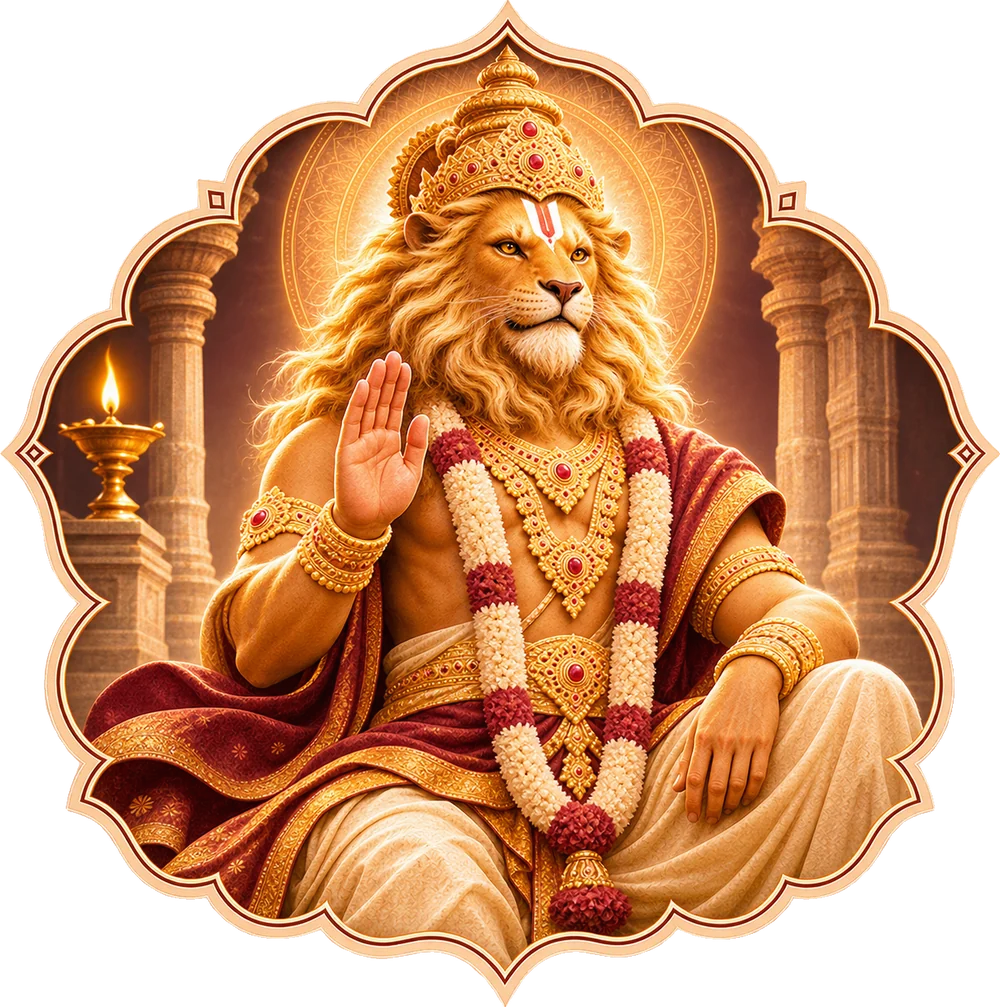
A roar shakes the hall. The pillar bursts. Out steps a figure such as no one has ever seen. It has the body of a man, with the head, mane and claws of a lion. It is Narasimha, the man-lion.
He seizes the king and carries him to the door. There he sits down on the threshold and lays him across his knees. It is the hour of dusk. With his claws he tears him open.
Every condition is fulfilled and at the same time bypassed. Narasimha is neither man nor animal and was not created by Brahma. The threshold is neither inside nor outside. The lap is neither earth nor air. Dusk is neither day nor night. Claws are no weapon.
How does Prahlada calm the man-lion?
Narasimha's anger does not subside. The gods dare not come near, even Lakshmi hesitates. Then Brahma sends the child forward.
Prahlada throws himself down before him without fear. Narasimha lays his hand on his head, and his face grows kind. Prahlada sings a long prayer.
Narasimha offers him any wish. Prahlada wants nothing for himself. A servant who asks for a reward, he says, is a trader. Then he does ask for one thing: that his father be forgiven.
Narasimha grants it. Prahlada becomes a just king. His grandson is Bali, of whom the story of Vamana tells.
What does the story of Narasimha mean?
Hiranyakashipu stands for the attempt to secure oneself cleverly against everything. His list has no gap, and yet life finds one. Dusk and the threshold are images of the in-between that cannot be regulated.
The pillar says something about God. He is everywhere, even in what seems lifeless. Prahlada does not have to call him. He is already there.
Prahlada himself is the model of fearless trust. He does not hate his father and in the end pleads for him. For many, this is where the true greatness of the story lies.
Narasimha is the fourth of the ten avatars. He is regarded as a protector in great danger.
Where is the story told?
It is in the Bhagavata Purana, in the seventh book, chapters 2 to 10. A shorter version is in the Vishnu Purana, in the first book, chapters 17 to 20. There the pillar is still missing.
The tale of Holika is not in the Bhagavata Purana. It belongs to the later tradition around the spring festival.
Important temples of Narasimha stand in South India, for example in Ahobilam and Simhachalam. His feast day is called Narasimha Jayanti and falls in early summer.
You will find more stories and all the figures at a glance in the library of the gods.
Frequently asked questions
Why did Vishnu appear as half man, half lion?
Hiranyakashipu could be killed neither by a human nor by an animal. Narasimha was neither and so met the condition.
Who is Prahlada?
Prahlada is the son of the demon king Hiranyakashipu. He worshipped Vishnu from childhood and is regarded as a model of devotion.
What does Holi have to do with Prahlada?
On the eve of Holi a fire burns. It recalls Holika, who wanted to burn Prahlada and was burned herself.
Which avatar is Narasimha?
In the usual list of Vishnu's ten avatars, Narasimha comes fourth, after the boar Varaha and before the dwarf Vamana.