




Who is Lakshmi?
Lakshmi is the goddess of prosperity, good fortune, fertility and beauty. More than money is meant: she stands for everything that makes a good life, from a rich harvest to inner contentment.
As consort of Vishnu, the preserver of the world, she accompanies him in all his descents. As Sita she is Rama's wife, as Rukmini Krishna's wife. So she is one of the central figures among the Hindu gods.
Another name for her is Śrī, “radiance, prosperity”. That is why Shri stands before the names of deities, saints and respected people. In Vaishnavism she counts as the mediator between believers and Vishnu.
What does the name mean?
The name comes from the Sanskrit word lakṣmī, “sign, good omen, fortune”. It is related to lakṣya, “aim”. So Lakshmi is the auspicious sign that points to success.
Even in the Vedic texts Śrī appears as the embodiment of radiance and prosperity. The famous hymn Shri Sukta stands in an appendix to the Rigveda, the so-called Khilani. It asks the goddess to bring prosperity into the house and calls her “the one who stands on the lotus”.
The story of the churning of the ocean of milk
The best-known story tells how Lakshmi rose from the ocean of milk. It stands, among other places, in the Vishnu Purana (book 1, chapter 9) and in the Bhagavata Purana (book 8).
The sage Durvasa had cursed Indra because he carelessly treated a garland of flowers he had been given. Then the gods lost their radiance, and good fortune left them with it. Together with the asuras they churned the ocean to win the drink of immortality, amrita. Mount Mandara served as the churning stick, the serpent Vasuki as the rope.
Many precious things rose from the sea. Among them was the goddess herself, seated on a lotus and radiant. She chose Vishnu as her consort and has dwelt on his chest ever since. The mark Śrīvatsa on Vishnu's chest recalls this. The reading in the tradition: good fortune does not stay where arrogance rules.
Stories about Lakshmi to read
You can read these stories about Lakshmi in full here. Each has its own page with its meaning and where it stands in the scriptures.
- Lakshmi and Bhrigua sage kicks Vishnu in the chest, where Lakshmi dwells. Offended, the goddess leaves heaven. Read the whole story
- The churning of the ocean of milkgods and demons seek the drink of immortality. First a poison rises. Read the whole story
Symbols of the goddess Lakshmi
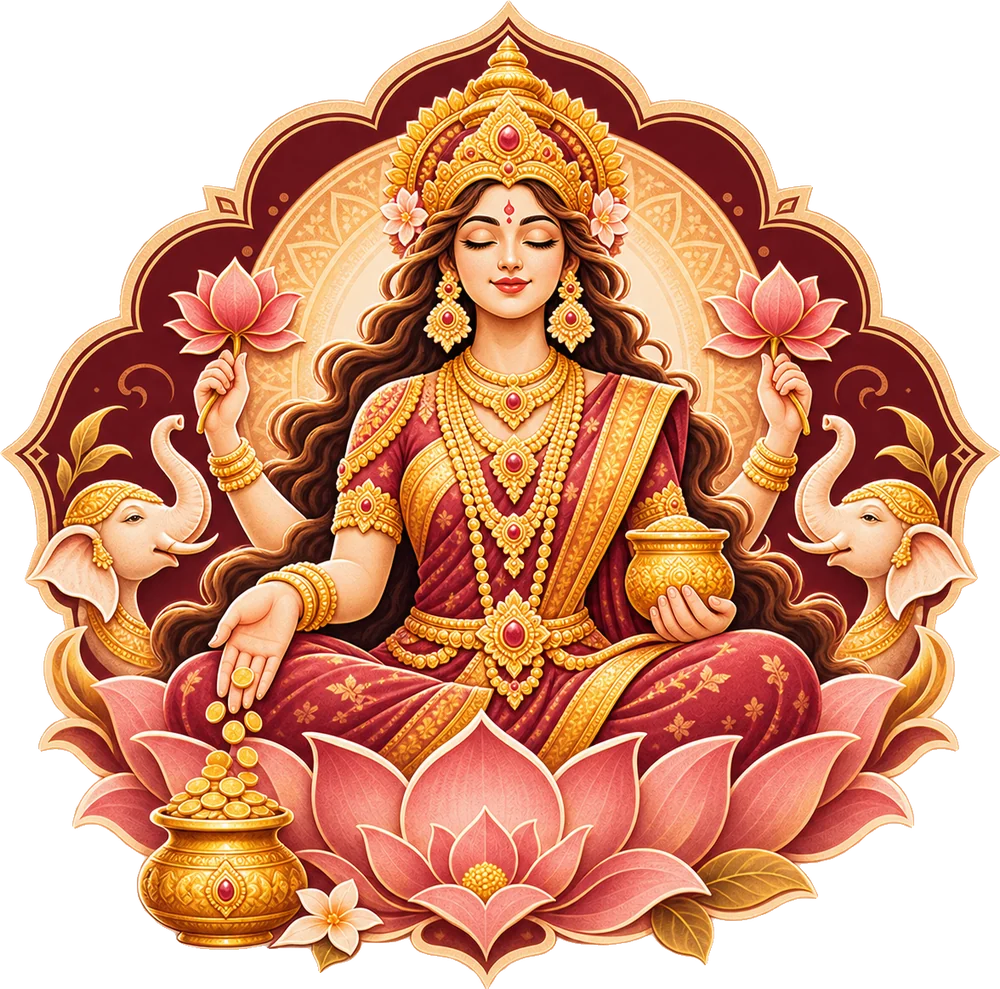
The goddess usually sits or stands on a red or pink lotus and wears a red garment with gold. Every detail has a meaning.
The image with two elephants is called Gajalakshmi. It is one of the oldest images of the goddess and is found even at early Buddhist sites such as Sanchi.
| Symbol | Meaning |
|---|---|
| Lotus (padma) | purity that grows in mud and still stays clean |
| Gold coins from her hand | prosperity that is passed on |
| Two elephants with water | rain, fertility, royal dignity |
| Owl (ulūka) | her vehicle, worshipped above all in East India |
| Gesture of blessing | protection and the granting of wishes |
The eight forms: Ashtalakshmi
In South India the goddess is often worshipped in eight forms. Each stands for a kind of abundance. The list varies a little by tradition; this one is widespread:
- Adithe original form.
- Dhanamoney and possessions.
- Dhanyagrain and food.
- Gajadignity and power, with elephants.
- Santanadescendants.
- Dhairyacourage and endurance.
- Vijayasuccess and victory.
- Vidyaknowledge.
The list shows well that prosperity is understood broadly in Hinduism: knowledge and courage count as much as grain and money.
Lakshmi and Alakshmi: fortune and misfortune
The goddess of fortune has a dark opponent: Alakṣmī, “not-Lakshmi”. She stands for poverty, strife and misfortune. In some stories she is Lakshmi's elder sister and also rose from the ocean of milk.
Even the Shri Sukta asks for Alakshmi to be driven away. The hymn names her together with hunger, thirst and dirt. This explains why cleaning and order matter so much before Diwali: where it is clean, Alakshmi finds no place.
In parts of Bengal Alakshmi is symbolically led out of the house with a small ritual on Diwali night before Lakshmi is invited in. In West India many families hang a lemon with green chillies on the door. The custom is meant to keep misfortune away.
A Lakshmi mantra to sing along
A widespread short mantra is oṃ śrīṃ mahālakṣmyai namaḥ. The syllable śrīṃ counts as her seed syllable. Many sing it on Fridays, the goddess's day, or during the evening light ritual.
Om, Shrim, salutation to the great Lakshmi.
| Word | Say it like | Meaning |
|---|---|---|
| oṃ | om, with a long o | the sacred primordial syllable |
| śrīṃ | shreem, with a long i and a nasal ending | seed syllable of radiance and abundance |
| mahālakṣmyai | ma-haa-laksh-myai | to the great Lakshmi |
| namaḥ | na-mah | salutation, greeting |
You will find further mantras, including verses from the Shri Sukta, translated word by word under Lakshmi mantra.
How old is the worship of Lakshmi?
The goddess is one of the oldest figures of Indian art. As early as around the 2nd and 1st centuries BCE, Gajalakshmi appears on the Buddhist stupas of Sanchi and Bharhut. Her image was evidently a general sign of fortune and blessing at the time, across the boundaries of religions.
Later, kings stamped her on their coins. On many gold coins of the Gupta dynasty (4th to 6th centuries) the goddess sits on a lotus or a lion. To this day business people in India display her image in their shops and begin their new account books at Diwali.
Diwali and other festivals
The goddess's most important festival is Diwali, the festival of lights in autumn. The Lakshmi Puja takes place on the new moon evening. Families clean the house, set out oil lamps and paint patterns of coloured powder in front of the door so that the goddess finds her way.
There are further festival days in the year. Their dates follow the lunar calendar.
- Sharad Purnima (Kojagari)a full moon night in autumn, above all in Bengal and Odisha.
- Varalakshmi Vratama fast day of married women in South India, on a Friday in the month of Shravana.
- Fridaysdedicated to the goddess all year round.
How to honour the goddess at home
You need no temple knowledge for a small devotion. In the tradition the goddess stays where order, generosity and gratitude prevail. Many families hold a simple ritual on Fridays or festival days, a short form of puja. This is how you can go about it:
- Prepare the placeclear a small surface and lay down a clean cloth. In the tradition order counts as an invitation to the goddess.
- Light a lampplace an oil lamp or candle in front of an image of the goddess. A flower or a few grains of rice are enough as an offering.
- Sing the mantraspeak or sing the mantra 11, 27 or 108 times. Read the translation once beforehand.
- Give thanksend the devotion with silent thanks for what you already have.
Frequently asked questions
What does the goddess Lakshmi stand for?
She stands for prosperity, good fortune, fertility and beauty. Both material and inner abundance are meant.
Who is Lakshmi's husband?
Lakshmi is Vishnu's consort. In his avatars she appears as Sita at Rama's side and as Rukmini at Krishna's side.
Why is Lakshmi worshipped at Diwali?
At Diwali the goddess is invited into the house with lights. The Lakshmi Puja on the new moon evening is the high point of the festival.
Which weekday belongs to Lakshmi?
Friday counts as Lakshmi's day. Many then sing her mantra or keep a small fast.
What is Lakshmi's vehicle?
Her vehicle is the owl, especially in East India. She is also often shown with two elephants.
Who is Alakshmi?
Alakshmi is Lakshmi's opponent and stands for poverty and misfortune. Even the Shri Sukta asks for her to be driven from the house.