




How does Manu find the fish?
In India Manu is regarded as the forefather of humankind. The Sanskrit word for human, manushya, is derived from his name. In this story the Bhagavata Purana calls him King Satyavrata.
One morning he stands by the river and scoops up water for his prayer. In his cupped hands swims a tiny fish. Manu wants to throw it back.
Then the fish speaks. Do not throw me back, it pleads. There the big ones eat the small ones. Protect me, and one day I will save you.
Manu feels pity. He puts the fish in his water pot and carries it home.
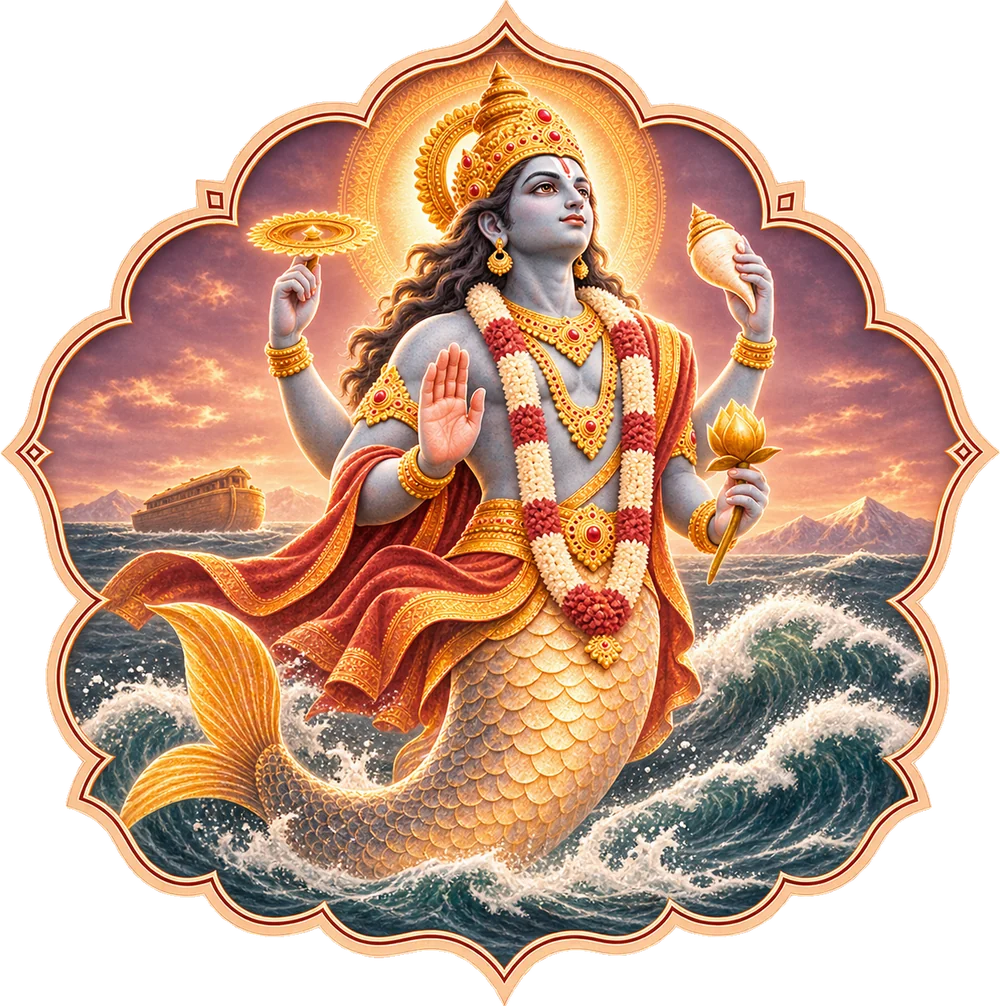
Why does the fish grow?
The next morning the fish fills the whole pot. Manu puts it in a well. Soon that is too small as well. He carries it to a pond, then to a lake.
The fish keeps growing. Manu brings it to the Ganga and finally to the sea. Even there it soon fills the horizon.
Now Manu understands that this is no ordinary animal. Who are you, he asks. In the Bhagavata Purana he recognises Vishnu and bows.
The fish announces what is coming. In seven days a flood will cover the three worlds. Build a ship, it says, or wait for the one I will send you.
What does Manu take with him on the ship?
The fish gives exact instructions. Manu is to gather the seeds of all plants and take animals of every kind. With him the seven sages are to go on board, the Saptarishi. They preserve knowledge.
On the seventh day clouds gather. Rain pours down, and the sea overflows its shores. Soon no land can be seen. Only the ship drifts on the water.
Then the fish appears. It is golden and has a single horn on its head. Manu ties the ship fast to it. In the Puranas the serpent Vasuki serves as the rope.
The fish tows the ship through storm and darkness. The voyage lasts a whole night of Brahma, that is, the length of a world age.
What does the fish teach during the voyage?
In the Bhagavata Purana the voyage is more than a rescue. Manu and the sages ask the fish questions. It instructs them about the self, about the world and about devotion.
A second task is added. While Brahma sleeps, a demon has stolen the Vedas from his mouth and carried them to the bottom of the sea. The fish kills him and gives the knowledge back to Brahma.
When the waters sink, the fish brings the ship to a peak in the Himalaya. Manu ties it to a tree there. In the old texts the place is called “Manu's descent”.
Manu climbs down slowly as the water sinks. He makes an offering and becomes the father of a new human race.
What does the story of Matsya mean?
At the beginning stands a small deed. Manu protects a being weaker than himself. In the end this care saves himself and all life. Many teachers see this as the core.
The growing fish can be read as an image of the divine. At first it shows itself as something inconspicuous. Every vessel a person gives it becomes too small.
The ship stands for what carries us through a time of upheaval. On board are seeds, animals and knowledge. What is preserved is what makes a new beginning possible.
The story fits the Indian view of time. Worlds arise, pass away and arise anew. The flood is a transition between two ages. With Matsya the series of the ten avatars begins.
Where is the story told and how old is it?
The oldest version is in the Shatapatha Brahmana, a Vedic prose text from about 2,700 years ago. There the fish is still nameless and no avatar.
In the Mahabharata the fish reveals itself as Brahma. Only the Puranas call it Vishnu. The detailed version is in the Bhagavata Purana, in the eighth book, chapter 24. The Matsya Purana is also named after it.
Flood stories exist in many cultures, for example in the Epic of Gilgamesh and in the Bible. Whether they are connected is an open question among scholars.
Matsya is depicted as a fish or as a figure with a human upper body and the body of a fish. Temples of his own are rare.
You will find more stories and all the figures at a glance in the library of the gods.
Frequently asked questions
What is the Matsya avatar?
Matsya is the first of Vishnu's ten avatars. In the form of a fish he saved Manu, the seven sages and the seeds of life from the great flood.
Who is Manu?
Manu is regarded as the forefather of humankind. The Manusmriti is also named after him. The word manushya, “human”, is derived from his name.
Where is the flood story told?
The oldest version is in the Shatapatha Brahmana. Later versions are in the Mahabharata, the Bhagavata Purana and the Matsya Purana.
Is the Indian flood story related to Noah?
The similarities are striking. Whether there is a common source has not been settled. Scholars do not agree on this.