




Who is Saraswati?
Saraswati is the goddess of knowledge, speech, music and art. Whoever learns, teaches or makes music asks her for a clear mind. In many schools in India her picture hangs at the entrance.
In later mythology she is regarded as the consort of the creator god Brahma. The idea behind it: creation needs knowledge and the word. With Lakshmi and Parvati she forms the Tridevi, the three great goddesses. That makes her one of the most important figures among the Hindu gods.
She is known outside India and Hinduism too, for example in Jainism and in Japan. More on that below.
What does the name Saraswati mean?
The name Saraswati means roughly “she who possesses waters” or “the flowing one”. It is made of saras (pond, body of water) and the ending -vatī (possessing, rich in). So the name recalls her origin as a river goddess.
Already in the Vedic scriptures the flowing of water is linked with the flowing of speech. In the Brahmana texts the goddess is equated with Vāc, divine speech. Other names are Sharada, Vagdevi (goddess of speech), Bharati and Vani.
Saraswati in the Rigveda: river and goddess
In the Rigveda Saraswati is first a mighty river in north-west India that is at the same time called on as a goddess. Several hymns praise her as the giver of wealth, offspring and inspiration.
Rigveda 2.41.16 is especially well known. There she is called ambitame nadītame devitame sarasvati: “best of mothers, best of rivers, best of goddesses”. Ralph T. H. Griffith translated the verse into English in 1896.
Which present-day river corresponds to the Vedic stream is disputed among scholars. The Ghaggar-Hakra river system, which today is mostly dry, is often named. In the tradition it flows on invisibly and meets the Ganga and Yamuna at Prayagraj.
Best of mothers, best of rivers, best of goddesses, Saraswati.
Rigveda 2.41.16, my own translation
Stories about Saraswati to read
You can read these stories about Saraswati in full here. Each has its own page with its meaning and where it appears in the scriptures.
- Saraswati and the GandharvasThe gods lose the goddess of speech to the heavenly musicians. They win her back with a song. Read the whole story
- Brahma in PushkarBrahma begins a sacrifice without his wife and takes a second one. Savitri curses him for it. Read the whole story
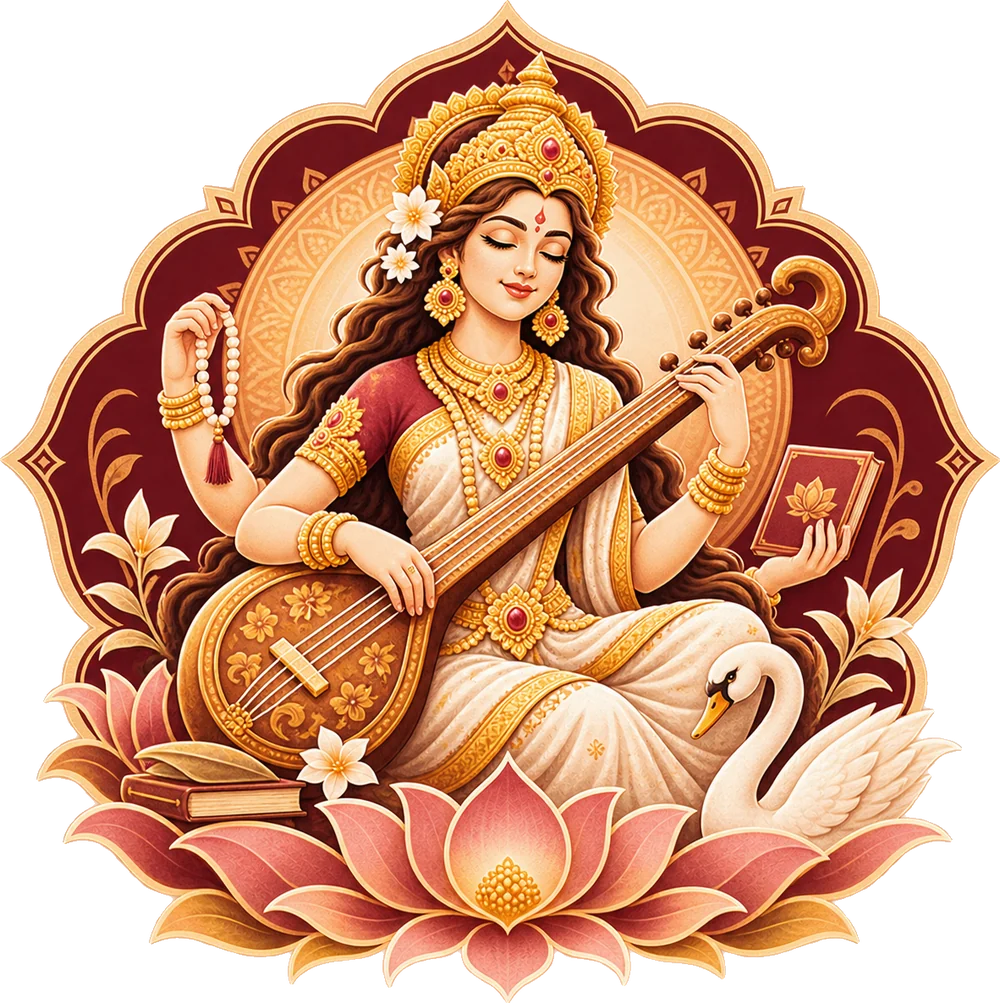
Symbols: veena, book, mala and swan
Each attribute of the goddess stands for an aspect of knowledge. The depiction is similar all over India; details can vary by region.
The swan has a lovely reading: according to an old belief it can separate milk from water. So it stands for viveka, the ability to tell the true from the untrue. Sometimes the goddess also sits beside a peacock.
| Symbol | Sanskrit | Meaning |
|---|---|---|
| Veena (string instrument) | vīṇā | music, art, harmony |
| Book or palm leaf | pustaka | knowledge, the Vedas, learning |
| Mala (prayer beads) | akṣamālā | meditation, repetition, concentration |
| Water pot | kamaṇḍalu | purity, creative power |
| Swan | haṃsa | telling the essential from the inessential |
| White lotus and white garment | padma | clarity, purity of mind |
Saraswati and the other great goddesses
The goddess of knowledge is often named together with Lakshmi and Kali. The basis is the tradition around the Devi Mahatmya (around the 5th to 6th century), the most important text of goddess worship. According to tradition each of its three parts is assigned to one form of the goddess.
The first part belongs to Mahakali, the second to Mahalakshmi, the third to Mahasaraswati. So the one goddess shows herself in three faces: as a dark, protecting power, as abundance and as clear knowledge. You can read more about the wild side of the goddess in the article on Kali.
The Navaratri festival mirrors this threefold division. In many regions the last three of the nine nights belong to the goddess of knowledge. In South India families then place books and instruments before her picture.
Saraswati in Jainism, Japan and Bali
The goddess of knowledge left India early. With Buddhist texts she travelled via China to Japan. There she is called Benzaiten and is one of the seven gods of good fortune. She usually holds a biwa, a lute, and is worshipped near water, for example on the island of Enoshima.
In Jainism she is regarded as the guardian of the teaching and of sacred knowledge. In Myanmar Buddhists know her as Thurathadi, the protective goddess of the scriptures.
On Bali Hindus celebrate Saraswati’s day every 210 days according to the Balinese calendar. On this day books and old palm-leaf manuscripts are blessed. Traditionally nobody reads or writes on that day.
The Saraswati mantra
The best-known short mantra to the goddess is oṃ aiṃ sarasvatyai namaḥ. The syllable aiṃ is her seed syllable (bīja). Many sing it before learning, practising or making music.
Om, Aim, salutation to Saraswati.
| Word | Say it like | Meaning |
|---|---|---|
| oṃ | om, with a long o | the sacred primordial syllable |
| aiṃ | aim, like “I’m” with a nasal end | her seed syllable, stands for knowledge and speech |
| sarasvatyai | sa-ras-vat-yai | to Saraswati |
| namaḥ | na-mah, a soft breath at the end | salutation, greeting |
You will find more mantras and the well-known prayer “Ya Kundendu” with translation under Saraswati mantra.
Read moreSaraswati Mantra: Meaning and TranslationVasant Panchami and other festivals
The most important Saraswati festival is Vasant Panchami, the fifth day of the waxing moon in the month of Magha. It usually falls between late January and mid-February and welcomes the spring.
On this day many people wear yellow, the colour of the flowering mustard fields. Children often write their first letters, a ritual called Vidyarambham or Akshar Abhyasam. In Bengal especially, Saraswati Puja is a big festival in schools and colleges.
- Vasant Panchamithe main festival in spring, with yellow as the festive colour.
- Navaratriin many regions the last nights belong to Saraswati.
- Vijayadashamiin Kerala and parts of South India the day when children begin learning.
How do you celebrate Saraswati Puja at home?
You can hold a small Saraswati Puja on Vasant Panchami or before an exam, a concert or a course. At its centre is whatever you learn and practise with. In Bengal pupils lay their books before the picture of the goddess and do not read in them that day. Only the next morning do they take the blessed books back.
- Make a placeLay a white or yellow cloth on a clean table and put a picture of the goddess on it.
- Add your toolsbooks, notebooks, a pen or your instrument, such as a harmonium or guitar.
- Bring offeringsa white or yellow flower, some fruit or a sweet and a light are enough.
- Sing the mantrasay oṃ aiṃ sarasvatyai namaḥ eleven times or sing one round with the mala.
- Put your request into wordssay in your own words what you need clarity for, and give thanks for what you can already do.
With Saraswati white stands for clarity, yellow for the spring at Vasant Panchami. Both colours suit her worship.
What Saraswati means for singers
For singers she is an obvious deity. She stands for sound itself, for voice, rhythm and text. Many kirtan groups begin a new song or a course with a short greeting to her.
You can say her mantra three times before studying or sing one round with the mala. If you want to understand how the goddesses belong together, read next about Lakshmi, the goddess of abundance. Each further goddess you get to know makes the picture of the whole goddess richer.
Frequently asked questions
What is Saraswati the goddess of?
She is the goddess of knowledge, wisdom, speech, music and art. Learners and musicians ask her for clarity and inspiration.
Who is Saraswati’s husband?
In later mythology she is the consort of Brahma, the creator god. In some texts she is also regarded as his power that came forth from him.
Why does Saraswati sit on a swan?
The swan stands for discernment. According to an old belief it can separate milk from water, just as wisdom separates the true from the untrue.
When is Vasant Panchami?
Vasant Panchami falls on the fifth day of the waxing moon in the month of Magha, usually between late January and mid-February.
Which mantra belongs to Saraswati?
The best-known short mantra is “Om Aim Saraswatyai Namah”. Aim is her seed syllable for knowledge and speech.
What colour belongs to Saraswati?
Her colour is white, which stands for clarity and purity. At Vasant Panchami many people wear yellow, the colour of spring.