




Who is Krishna?
Krishna is a god with many faces. As a child he steals butter, as a youth he plays the flute for the cowherd girls. As an adult he is prince of Dvaraka and counsellor in the great war of the Mahabharata. Hardly any other god is worshipped at so many ages of life.
Theologically there are two views. In the classical list he is the eighth avatar, a descent of Vishnu to earth. For traditions such as Gaudiya Vaishnavism it is the other way round: Krishna is the original form of God, from whom Vishnu also comes forth. They refer to the Bhagavata Purana (1.3.28), which says: kṛṣṇas tu bhagavān svayam, “but Krishna is God himself”.
How he relates to the other deities is shown in the overview Hindu gods. Both readings are alive. Many believers simply worship him as the god who is closest to them.
What does the name Krishna mean?
The Sanskrit word kṛṣṇa means “black” or “dark”. That is why he is usually shown with dark blue skin, the colour of a rain cloud. A later, theological interpretation derives the name from kṛṣ, “to attract”. Then it means “the all-attractive one”, who draws all hearts to himself.
He has many epithets. Govinda and Gopala mean “protector of cows”. Vasudeva names him as the son of Vasudeva, and Madhava and Keshava are other common names. You may already know many of them from kirtan songs.
Krishna's childhood and the Krishna lila
Krishna is born in Mathura, in the prison of the tyrant Kamsa. His parents are Devaki and Vasudeva. A prophecy tells Kamsa that their eighth child will kill him. That very night Vasudeva carries the baby across the river Yamuna to Gokul. There the child grows up with Nanda and Yashoda.
The tradition calls the stories of his childhood and youth līlā, divine play. They appear mainly in the tenth book of the Bhagavata Purana. Here God acts out of joy, without purpose. These episodes are the best known:
- The butter thiefthe little one and his friends steal butter from the neighbours' pots. As punishment Yashoda ties him to a mortar, but the rope is always too short.
- The universe in his mouthYashoda looks into his mouth because he is said to have eaten earth. She sees the whole universe inside.
- The serpent Kaliyahe dances on the heads of the venomous serpent poisoning the river Yamuna and drives it away.
- Mount GovardhanaIndra punishes Vrindavan with storm and rain. Then the boy lifts Mount Govardhana and holds it like an umbrella over the people for seven days.
- The rasa danceon an autumn night he dances with the gopis, the cowherd girls, in the moonlight. Each believes he is dancing only with her.
The gopis, and Radha above all, stand for the soul longing for God. The article Radha Krishna explains more.
Stories about Krishna to read
You can read these stories about Krishna in full here. Each has its own page with its meaning and where it appears in the scriptures.
- Krishna's birtha king fears his sister's eighth child. At midnight it is born in the prison. Read the whole story
- Krishna, the butter thieflittle Krishna steals butter. His mother wants to tie him up, but the rope is always too short. Read the whole story
- Krishna and Govardhanthe herders stop making offerings to the rain god. Indra sends a flood, and Krishna lifts a mountain. Read the whole story
- Krishna and Kaliyaa venomous serpent poisons the Yamuna. Krishna jumps into the water and dances on its heads. Read the whole story
- Ganesha and the moonthe moon laughs at Ganesha and is cursed. Since then it wanes and waxes again. Read the whole story
Krishna in the Mahabharata and the Bhagavad Gita
As an adult, Krishna leaves Vrindavan, defeats Kamsa in Mathura and later founds the city of Dvaraka by the sea. In the Mahabharata he is friend and relative of the five Pandava brothers. In the war against their cousins, the Kauravas, he does not fight. But he drives the chariot of the hero Arjuna.
Before the battle on the field of Kurukshetra, Arjuna loses heart. He does not want to fight his teachers and relatives. His charioteer answers him with a teaching on duty, action, devotion and the immortal self. This dialogue is the Bhagavad Gita, 18 chapters and about 700 verses in the sixth book of the Mahabharata.
In the eleventh chapter he shows Arjuna his cosmic form, the viśvarūpa. In it Arjuna sees all worlds, all gods and all time. This scene makes clear why, for many, he is God himself.
According to tradition, Krishna's life on earth ends near Dvaraka. A hunter mistakes his foot for a deer and strikes him with an arrow. According to the Puranas, his death marks the beginning of the Kali Yuga, our present age.
Whoever offers me with devotion a leaf, a flower, a fruit or water, that offering I accept.
Bhagavad Gita 9.26, own translation
Did Krishna really live?
Whether Krishna was a historical person cannot be proven. But there are early traces of his worship. The Chandogya Upanishad (3.17.6) mentions a “Krishna, son of Devaki” as the student of a sage. Whether it means the same figure is disputed.
A clear testimony is set in stone. Around 113 BCE, the Greek envoy Heliodorus had a pillar erected at Vidisha in central India. The inscription dedicates it to Vasudeva, the “god of gods”. It calls the donor a bhāgavata, a worshipper of this god.
The tradition dates Krishna's life much earlier. By its reckoning, the Kali Yuga began with his death in 3102 BCE. Scholars rather see him as a figure in which several traditions merged: the hero Vasudeva, the herder god of Braj and the teacher of the Gita.
How do you recognise Krishna?
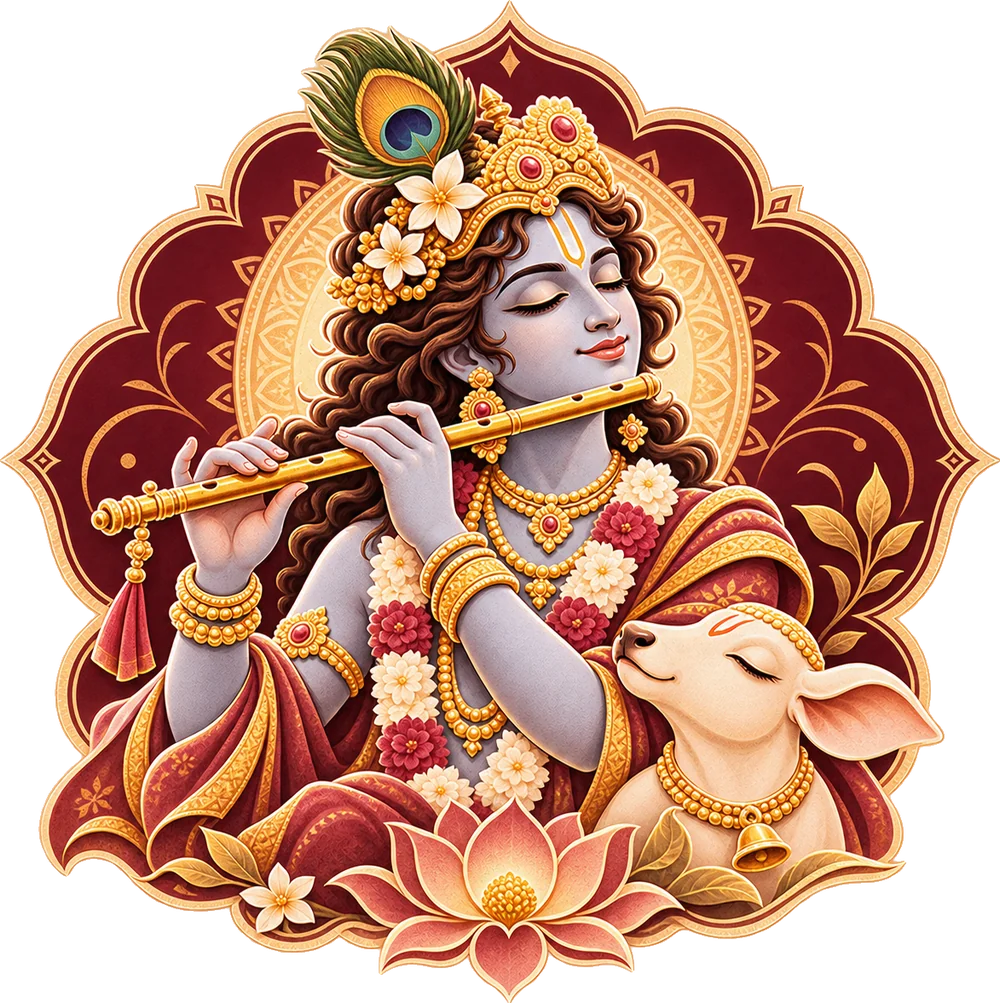
Krishna is easy to recognise in pictures. The table shows his main features and how they are commonly interpreted.
| Symbol | Meaning |
|---|---|
| Flute (bansuri) | God's call to the soul. Whoever hears it leaves everything behind. |
| Peacock feather | Beauty and play, a greeting from the forest of Vrindavan. |
| Dark, blue skin | The colour of rain clouds and the endless sky. |
| Cow and calf | His time as a herder and his care for all beings. |
| Yellow garment | Pitambara, the garment of Vishnu, showing him as Vishnu's form. |
There are also regional forms. As Bal Gopal he is the toddler, often crawling with a ball of butter. As Jagannath he lives in the temple of Puri in Odisha. As Vithoba he is sung to in Pandharpur in Maharashtra, as Shrinathji in Nathdwara in Rajasthan.
Krishna in bhakti: poets, saints and kirtan
No other god has so many songs dedicated to him. In the 12th century the poet Jayadeva sang of the love of Radha and the dark herder in the Gita Govinda. In the 15th and 16th centuries came great bhakti saints such as Chaitanya in Bengal, Surdas in Braj and the poet Mirabai in Rajasthan. Their stories are told in the article bhakti saints.
Chaitanya shaped the practice of singing the divine names together in streets and squares. Today's kirtan movement, which made the Hare Krishna mantra known worldwide, comes from his tradition. Anyone who sings kirtan in the West today often stands in this line.
For bhakti, the path of devotion, he is the ideal counterpart. You can love him like a child, like a friend or like a beloved. In the tradition these different kinds of relationship are called rasa, the taste of love.
Festivals and mantras for Krishna
His birthday is Janmashtami in August or September. Devotees fast until midnight, the hour of his birth, and then sing together. Holi is also closely linked to him and is celebrated for many days in Braj, around Mathura and Vrindavan. On the day after Diwali, Govardhan Puja remembers the lifting of the mountain.
The best-known mantra is the Hare Krishna mantra with 16 names, which is heard in kirtans all over the world. Older and shorter is the twelve-syllable mantra to Vasudeva. It appears in the Bhagavata Purana and is still recited in japa and puja today.
Om, salutation to the exalted Vasudeva.
| Word | Say it like | Meaning |
|---|---|---|
| oṃ | om | The sacred syllable. |
| namo | na-mo | Salutation (before a soft sound, namaḥ becomes namo). |
| bhagavate | bha-ga-va-te | To the exalted one, the Lord. |
| vāsudevāya | vaa-su-day-vaa-ya | To Vasudeva, the son of Vasudeva, or the one who dwells in all. |
If you want to get to know Krishna, start with a story and a song. Read, for example, the scene at Mount Govardhana and then sing a few rounds of the mantra. That way image and sound come together, and the name gains content.
Frequently asked questions
Is Krishna an avatar of Vishnu?
In the classical list he is the eighth avatar of Vishnu. Gaudiya Vaishnavism, by contrast, sees him as the original form of God.
Why is Krishna blue?
His name means “the dark one”. That is why painters show him blue, the colour of rain clouds and the endless sky.
Who are Krishna's parents?
His birth parents are Devaki and Vasudeva. But he grows up with the herders Nanda and Yashoda in Gokul.
What is the Krishna lila?
Lila means play. It refers to the stories of his childhood and youth in Vrindavan, mainly from the Bhagavata Purana.
Did Krishna really live?
It cannot be proven. But a pillar inscription from Vidisha shows that Vasudeva Krishna was already worshipped as a god around 113 BCE.
Which mantra belongs to Krishna?
The best known is the Hare Krishna mantra. Older is Om Namo Bhagavate Vasudevaya.