




What is karma? The meaning of the word
Karma first simply means “action”. The word is the basic form of the Sanskrit noun karman, derived from the verbal root kṛ, “to do, to make”. The Sanskrit dictionary of Monier-Williams gives the meanings “act, action, performance”.
In the Rig Veda, the oldest text of India, karman means above all the sacred act of sacrifice. Only in the early Upanishads, around the 7th and 6th century BCE, does it become a teaching: every deed leaves a trace, and this trace shapes the future of the person who acts.
This includes more than what you do with your hands. The Indian traditions name three levels: deeds, words and thoughts. What matters is the intention behind the action.
action, deed, work
| Word | Say it like | Meaning |
|---|---|---|
| kṛ | kri, with a short i | root: to do, to make, to bring about |
| -man | man | ending that turns a verb into a noun |
| karman | kar-man, stress at the front | what is done, the action and its effect |
What do the Upanishads and the Gita say about karma?
The first clear teaching of karma is in the Brihadaranyaka Upanishad. Verse 3.2.13 says one becomes “good through good deeds, bad through bad deeds”. Elsewhere (4.4.5) the text describes a whole chain: as your desire is, so is your will. As your will is, so is your deed. And as your deed is, so you become.
This chain is the core of the teaching. The effect begins in wishing and willing, long before a hand moves. That is why the Indian paths of liberation start with the mind.
The Bhagavad Gita takes the thought further. It says that no one can be without action for even a moment (3.5). So what matters is how you act. Krishna teaches Arjuna to act without clinging to the result. This is the path of karma yoga, explained in detail in chapter 3 of the Gita.
The Gita also admits that the subject is hard: “Deep is the way of action”, says verse 4.17. And it shows a way out. As fire turns wood to ash, the fire of knowledge burns all deeds in their binding power (4.37).
Your right is to action alone, never to its fruits. Let the fruit not be your motive, and do not cling to inaction either.
Bhagavad Gita 2.47, my own translation
How does karma work? Seed, trace and fruit
The texts describe the effect with an image from farming. Every deed is a seed, and its consequence is called phala, “fruit”. Like a seed it needs time and the right conditions to ripen.
Patanjali's Yoga Sutras explain where the seeds lie. Every action leaves impressions in the mind, called saṃskāra. Their store is rooted in the afflictions of the mind, such as ignorance, craving and aversion (Yoga Sutra 2.12). When it ripens, according to verse 2.13 it determines three things: birth, lifespan and experiences.
Something practical follows from this. Repeated deeds become habits, habits become tendencies. Whoever reacts impatiently every day strengthens impatience. Whoever practises kindness every day strengthens kindness. So karma already works in this life, without any thought of rebirth.
Patanjali says in Yoga Sutra 4.7 that the deeds of a yogi are “neither white nor black”. What is meant is action that no longer plants new seeds.
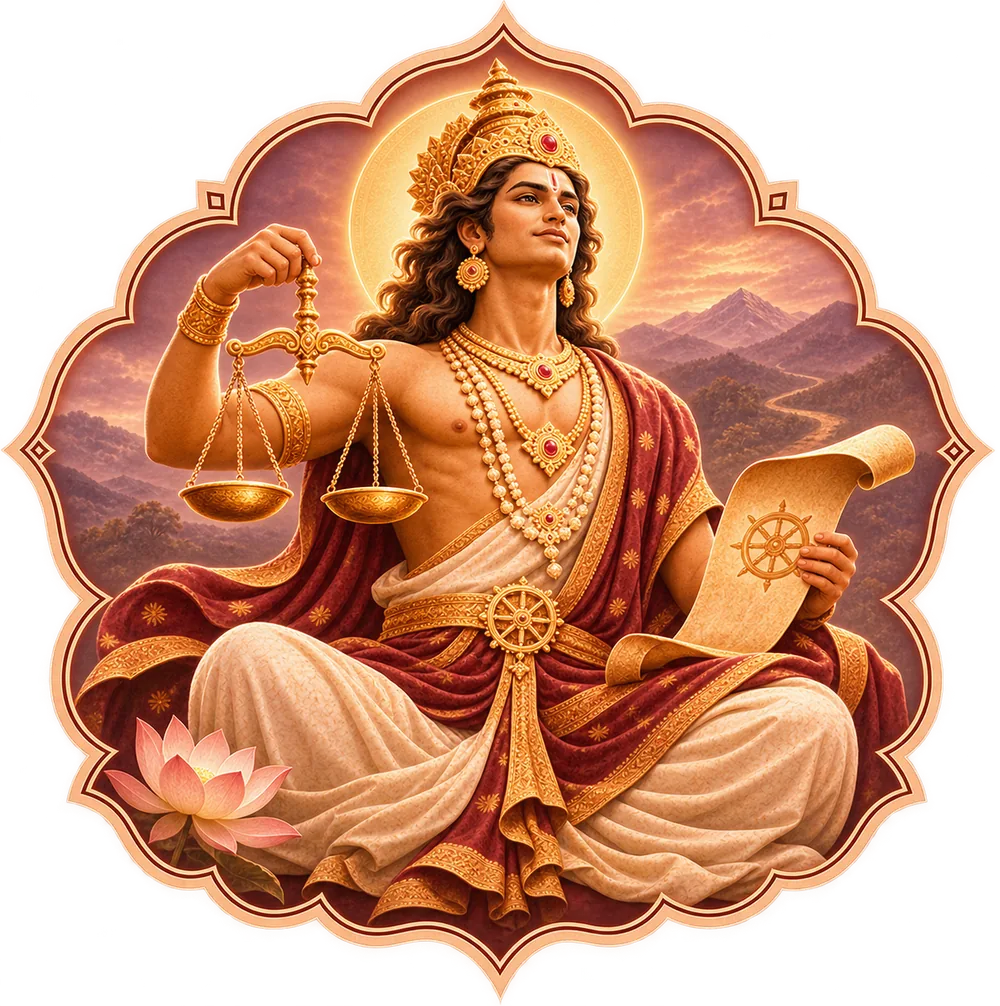
The three kinds of karma
Vedanta distinguishes three kinds, depending on when an action shows its effect. A common teaching image is the archer: the arrows in the quiver, the arrow already shot and the arrow being set to the string.
| Name | Meaning | The archer image |
|---|---|---|
| Sanchita (sañcita) | accumulated effects from all earlier lives | the arrows in the quiver |
| Prarabdha (prārabdha) | the part that ripens in this life and shapes it | the arrow already in flight |
| Agami (āgāmi), also kriyamana | new effects from your present action | the arrow you are setting to the string |
According to Shankara, the great teacher of Advaita Vedanta, knowledge dissolves the accumulated and the new. The prarabdha, by contrast, runs its course like an arrow already shot. That is why even a liberated person lives on until their body dies.
Karma in Hinduism, Buddhism and Jainism
All three religions of India know the principle, yet explain it differently. In Hinduism it works together with samsara, the cycle of rebirths. Many theistic schools say that God allots the fruits of deeds. The Brahma Sutras give the reason for this in verse 3.2.38.
The Buddha put the emphasis entirely on intention. In the Anguttara Nikaya (6.63) he says: “Intention, monks, is what I call kamma.” Kamma is the Pali form of the word. Whoever harms a beetle without intending to creates no grave consequence, according to this teaching.
In Jainism karma is something material. The finest particles cling to the soul, attracted by passion and violence. That is why Jains take non-violence so seriously: every injury binds new particles.
| Tradition | What has an effect? | Goal |
|---|---|---|
| Hinduism | deeds, words and thoughts; often repaid by God | moksha, liberation through knowledge, devotion or selfless action |
| Buddhism | intention (cetanā), with no eternal soul as its carrier | nirvana, the extinction of greed, hatred and delusion |
| Jainism | fine matter that clings to the soul | liberation of the soul through asceticism and non-violence |
Five myths about karma in the West
The idea came to the West in the 19th century, strongly shaped by the Theosophical Society. Since then its meaning has shifted. You will meet these five errors most often:
- Karma is a system of punishmentIn the texts there is no angry judge. The teaching is more like a law of nature, the way a seed becomes its plant.
- Everything is fateOnly the prarabdha is already fixed. Your present action stays free and creates new causes.
- The bill comes at onceThe idea of “instant karma” comes from pop culture. The texts speak of effects that often ripen only late.
- Suffering is self-inflictedThe teaching never justifies refusing help to those who suffer. Compassion and service to others count as good action themselves.
- The goal is to collect good deedsThe good binds too if you cling to it. Even sattva, the purest of the three qualities, binds through attachment to happiness (Bhagavad Gita 14.6).
Karma, dharma and rebirth
In Indian thought karma never stands alone. It forms a triangle with dharma and samsara. Dharma is the right order, the question of how you should act. Karma is the action itself and its effect. Samsara is the cycle in which these effects continue over many lives.
A serious and at the same time hopeful thought follows from this. Your present is partly the result of earlier deeds. Your future, however, arises from what you do now. The Upanishads call the end of the cycle moksha, liberation.
In daily life: how to put the teaching into practice
The Gita makes action a practice for every day. You do not need to withdraw from the world for it. These four steps describe the core of karma yoga:
- Check your intentionBefore a decision, ask yourself from which motive you act. According to the Upanishads and the Buddha, this is exactly what counts.
- Act fullyDo what needs to be done as well as you can. The Gita calls yoga “skill in action” (2.50).
- Let go of the resultInwardly offer the result to the divine. “Whatever you do, do it as an offering to me”, says Krishna in verse 9.27.
- Serve without returnSelfless service is called sevā. In many ashrams it counts as the most direct form of this path.
Many kirtan singers also experience singing together as an offering of this kind: you sing without wanting anything. You will find related terms such as dharma, samsara and moksha in the Sanskrit glossary. With the Sanskrit flashcards you memorise these words along the way.
Frequently asked questions
What does karma mean in English?
Karma literally means “action” or “deed”. In the wider sense it means the principle that every intentional action has consequences for the person who acts.
Is karma the same as fate?
No. Only one part, the prarabdha, counts as fixed. Your present action is free and shapes your future.
Is there good and bad karma?
Yes, the texts speak of good and bad deeds with corresponding results. The Bhagavad Gita stresses, however, that good deeds also bind if you cling to the result.
What is the difference between karma and dharma?
Dharma is the right order and describes how one should act. Karma is the action itself and its effect.
What does karma mean in Buddhism?
In Buddhism what counts above all is the intention behind a deed. In the Anguttara Nikaya 6.63 the Buddha says that he calls intention kamma.
Can karma be dissolved?
According to the Bhagavad Gita (4.37), knowledge burns up the effect of earlier deeds. According to the Gita, whoever acts without clinging plants no new binding seeds.